|
Bronze Age
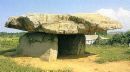
Dolmen
The Bronze Age is often held to have begun around 1500 ~ 1000 BCE in Korea, though recent archaeological evidence suggests it might have started as far back as 2500 BCE, through the developed areas of Manchuria as migrating Altaic tribes entered Korea. Bronze daggers, mirrors, and weaponry have been found, as well as evidence of walled-cities. It is believed that by the third century BCE, iron culture was developing and the warring states of China pushed refugees eastward and south. Recently however, an iron mirror has been found in Songseok-ri Kangdong-gun Pyongyang in North Korea, that may have originated from 1200 BCE.Dolmen burial sites with huge stones, some weighing as much as 60 tons are found as well .
The most ancient ruins of Korea - Dolmen : Gochang 고창 고인돌 In Korea, the total number of known dolmen is estimated to be around 30,000. Gochang(고창) is the largest Dolmen site in Asia which holds more than 447 dolmens and was officially registered with UNESCO on November 29, 2000. The influx of people at this time from eastern China brought more developed agricultural practices such as the cultivation of rice and undecorated red pottery .Around 300 BC, iron was introduced and the first evidence of the underground ondol heating system .
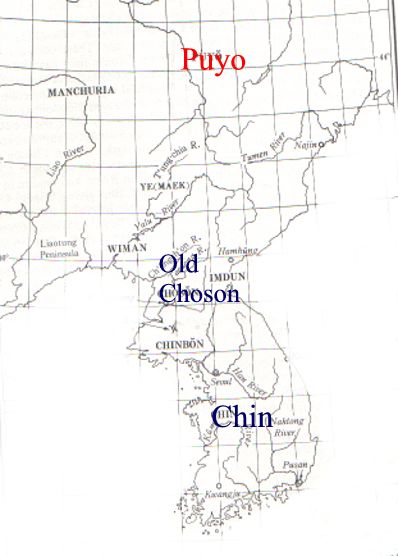
Sometime during the late Bronze Age, half a dozen loosely affiliated walled-town states grew powerful on the peninsula and in Manchuria, and kingships became institutionalized. Of these, the most significant were Puyo ( Buyeo ), in the middle Sungari River basin of central Manchuria; Old Choson ( Gojoseon ), spread from the Liao River in southern Manchuria to the Taedong River in North Korea; and Chin (Jin), which occupied the peninsula's lower region.
Old Choson
Gojoseon (Hangul: 고조선; Hanja: 古朝鮮, Korean pronunciation: [kodʑosʌn]) was an ancient Korean kingdom. Go (고, 古), meaning "ancient," distinguishes it from the later Joseon Dynasty; Joseon, as it is called in contemporaneous writings, is also romanized as Chosŏn.
According to the Samguk Yusa and other medieval-era records, Gojoseon is said to have been founded in 2333 BC by Dangun, who is said to be a Posterity of Heaven. Archaeological evidence of a Gojoseon-era civilization is found in the transition from the Jeulmun pottery to the Mumun pottery around 1500 BC, when groups of semi-sedentary small-scale agriculturalists occupied most of the Korean Peninsula. Local bronze production began around the 8th century BC.
Based on contemporaneous written records, modern historians generally believe it developed from a loose federation into a kingdom between the 8th and 4th centuries BC. During its early phase, the capital of Gojoseon was supposedly located in Liaoning; around 400 BC, this was moved to Pyongyang, while in the south of the peninsula, the Jin state arose by the 3rd century BC.
Gojoseon was collapsed by Han Dynasty of China during the Gojoseon--Han War in 108 BC, and this led to emergence of small states, which said Proto--Three Kingdoms period in Korean history. The people of Gojoseon are referred to in Chinese records as Dongyi ("eastern barbarians"). Their linguistic affiliation is uncertain. Their language was probably a predecessor of the equally prehistoric Buyeo languages, and perhaps a form of Proto-Korean. These states were the first to be mentioned in Chinese records. Old Choson closest to China-was the most advanced and the strongest. lts people were known to the Chinese as the Dongyi or "eastern barbarians" or "eastern bowmen." Old Choson ( 고조선 古朝鮮 Gojoseon ) in the Taedong river basin.Yemaek on the Yalu river and the state of Chin on the Han river . Old Choson was the first state on the peninsula to appear in historical documents, is the Old Choson started as a Principate of Chi-tzu who was a prince of the late Yan Dynasty of China. The most advanced of these was old Choson . According to legend, Dangun Wanggeom founded Old Choson in 2333 B.C.. Modern historians generally consider Old Choson to have developed into a powerful federation or kingdom by around 4th century BC in the basins of the Liao and Taedong Rivers, ruling over northern Korean peninsula and southern Manchuria. Around 300 BC, Gojoseon lost significant western territory after a war with the Yan ( 燕 ) state in China .Under pressure from the Chinese state of Yan, which invaded the Liaotung Peninsula at the end of the 4th cent B.C., the Old Choson fell into a period of decline .
Wiman Choson After repeated warfare with various Chinese kingdoms, Old Choson was overcome in 190 B.C. by Wiman, an expatriate of one of those kingdoms, who founded Wiman Choson ( 위만조선 衛滿朝鮮 ). Wei Man or Wiman, a former subject of Yan, was an exile from China. Chi Chun, the ruler of Wiman at that time, trusted the Chinese exile and awarded him a post of great importance only to be betrayed and driven off the throne. Wei Man became the ruler of Wiman Choson but his descendants ruled for only three generations-less than 100 years-before their kingdom was conquered by Wu-ti, the great Emperor of Han China. In 109 B.C. emperor Wu-ti of the Han Dynasty sent land and sea forces to capture Wang-chien-cheng, the captial of Wiman near present day Pyongyang . The area between the Han River and the middle of Manchuria was made into four provincial commands, ruled by the Chinese as an outpost colony. In northern Manchuria, Puyo continued to survive for some time, and Chin (Jin) was basically left alone in the southern portion of the peninsula. Chin's capital was somewhere south of the Han River. It preceded the Samhan confederacies, which each claimed to be successors of the Jin state. Puyo Buyeo Buyeo or Puyo ( 부여 夫餘 ) emerged in the region of the Sungari river basin in Manchuria . The first reference to Puyo occurs around the 4th century BC. There are records of Puyo envoys in China in 49 AD .Usually, Puyo was allied with Chinese states against Koguryo and the nomadic people to its north .When the Chinese state of Chin was driven south by the tribes of the north, Puyo became isolated and was absorbed by Koguryo. Puyo is also the name of one of the capitals of Paekche.
|
||||
|
100 BC-300 AD |
||||