|
Choson or Joseon Dynasty 조선국 朝鮮 1392 - 1910
King Taejo, born as Yi Seong-gye, founder and the first king of the Joseon Dynasty Early Period Joseon (Korean: 조선; Hanja: 朝鮮; also Chosŏn, Choson, Chosun, Cho-sen), was a Korean state founded by Taejo Yi Seong-gye that lasted for approximately five centuries, from July 1392 to October 1897. It was founded following the aftermath of the overthrow of the Goryeo Dynasty in what is today the city of Kaesong. Early on, Korea was retitled and the capital was relocated to modern-day Seoul. The kingdom's northernmost borders were expanded to the natural boundaries at the Amnok and Duman rivers through the subjugation of the Jurchens. Joseon was the last dynasty of Korean history and the longest-ruling Confucian dynasty. At 518 years (1392-1910), the Choson Dynasty is the nation's longest-lived. Its founder, Yi Songgye, took the dynastic name Taejo ("Great Progenitor"), moved the capital to Hanyang (Seoul), and named the dynasty after the ancient Choson Kingdom. This ended the Koryo Dynasty Wang family's rule and supplanted it with the Chonju branch of the Yi family. Referring to this family name, the Choson Dynasty is often mistakenly called the Yi Dynasty.
Women on Tano Day, by Shin Yun-bok, early 19th cent
Diplomatic relations were renewed with the Ming Chinese, and conflicts with northern nomadic tribes were resolved. During the reign of King Sejong (1418-50), the territory was extended to the Amnok and Tuman rivers, the present northern border of North Korea. At that time, the country was split into eight provinces, which have come down to this century basically unchanged. Regional capitals were set up in each province, and provincial armies and navies established. A system of beacon-fire communication sites and a series of postal relay stations were set up to transfer messages throughout the kingdom.
Throne in the Kyongbokkung Palace, built by King Taejo in 1398 in Seoul after moving his capital from Kaesong. As Buddhism fell from favor, Confucianism arose as the dominant political and social force. The strict social hierarchy of Confucianism placed the king at the pinnacle with royalty directly below; under that was the aristocratic yangban class, which had expanded since the Koryo Dynasty. Below that fell the commoners -tenant farmers and fishermen, many of whom had lost their rights and free status over the centuries as taxes and rents grew unbearable. At the bottom of the pile were outcasts, commoners who were employed in undesirable occupations, and slaves. Social classes became hereditary because intermingling was nearly impossible. This rigid system relaxed somewhat in the dynasty's latter years, when a merchant class arose (and some families were able to buy into or were granted the rank of yangban and many traditional yangban families lost status and economic stability.
video of Joseon photos The system of government set up by King T'aejo, and carried on by his successors, was one of counselors and department ministers. Final authority rested in the king, but suggestions were entertained at all levels. Government officials received land in relation to their rank. When land became scarce, salaries were paid. Although all land was officially owned by the king, yangban were allowed to collect rent on their allotted parcels and maintain slaves. Over the centuries, private holdings grew large, increasing the power and prestige of select yangban and reducing the leverage of the king. To insure a sizable pool of educated young men for government service, additional public and private schools were established, and civilian service, military, and other exams were instituted. In the Confucian tradition, great importance was placed upon education, for through it one could achieve position and rank, and ultimately influence, power, and property. The strict Confucianist system seemed to work well through the first two centuries of the dynasty, and the integrity of public officials remained high. Moved by idealism, nationalism was strong, and the country's welfare primary. The emphasis placed on scholarship and the arts fostered output of national histories, scientific treatises, technology, medicine, increased use of printing to disseminate information, and interest in calligraphy, painting, and porcelain. One of Korea's proudest achievements, the indigenous han'gul script, was promulgated in 1446 by King Sejong. Eventually, the yangban class became too influential for the king to tolerate. Between 1498 and 1545 there were four great literati purges. In response, many scholars went to the country to study and open sowon (private academies), while others resumed to their ancestral homes to farm. The 1500s also saw a series of peasant uprisings and the emergence of bandits in response to excessive tax burdens, the land grabbing of yangban, and the deteriorating social condition of the lower classes. Then, after some two centuries of Japanese raids on the Korean coast, a formal treaty was signed in 1443 that organized trade and opened three ports in the southeast corner of the peninsula. Korean trade was supervised by government agents; the Lord of Tsushima handled trade for Japan. Trade items from Korea were largely agricultural, handicraft, artistic, and religious; from Japan came raw materials and silver. The Imjin War (1592–1598) The Imjin War (1592-98), (more details on Imjin War ) also known as the Hideyoshi Invasions, was one of the most disastrous periods of Korean history. Shortly after consolidating control of Japan, the great general Toyotomi Hideyoshi decided to invade China in an attempt to become the ruler of all Asia. The easiest route to China cut through the Korean Peninsula. He asked the Korean king for help, or for unobstructed passage. As Korea had strong diplomatic relations with the Ming Dynasty, the king refused. To teach Korea a lesson, Japanese troops attacked Korea in April 1592 with their full military might. Although there had been voices in the Korean government calling for the strengthening of the military, the crown did not take note and Korea was virtually defenseless when Japan let loose its battlehardened troops. Japanese troops pushed up to the capital in two weeks, forcing King Sonjo to flee. A few weeks later the Japanese were in P'yongyang. Except in a few fortified southern towns, Korean opposition consisted largely of hastily organized guerrilla troops led by local yangban. Against Japanese rifles (copies of Portuguese models, never before seen by Koreans), they resisted bravely with arrows, cannons, and explosives, but still lost nearly every encounter. Finally, following the arrival of a large Ming force to assist the Koreans, the Japanese slowly retreated to the south coast. Peace negotiations were held between the Chinese and Japanese, with no agreement; skirmishes continued until 1596. In 1597 there was a second great invasion, which the combined Korean and Chinese armies confined to the two southern provinces. Still, there was great loss of Korean life and property.
video of Korean ladies hairstyles from ancient times to the j Joseon Dynasty Korea's saving grace was its navy. As in 1592, 1597-98 saw many great naval victories for the Koreans. The kobukson was introduced and put to good use. It was a small, extremely maneuverable wooden warship roughly the shape of a turtle. Cannons were mounted on all sides, and spiked metal plates covered its humped top to discourage boarding.Moved by sail or oar, these ships could dart around and harass the larger and 5 more ponderous Japanese boats. Led by Admiral Yi Sun-shin, the Korean navy crippled Japanese supply lines to the peninsula, sinking supply ships and troop carriers by the dozen. In 1598 Hideyoshi died and the Japanese decided to end the war and return home. During the last major sea battle in Nov. 1598, Admiral Yi was killed. Throughout this conflict, the Japanese had raped, pillaged, and plundered. Crops were razed, buildings burned, movable treasures taken, and other objects destroyed. Korea lost a great portion of its most valuable cultural properties. The government was drastically weakened, the economy was in shambles, and famine resulted. Ming China also suffered loss and economic decline, which contributed to its downfall. Unfortunately for Korea, its troops also looted the country after the war on their return to China. Japan however, fared far better. Although it did not reach its goal of penetrating China, it boosted its economy and helped solidify the country under Hideyoshi's successor, Tokugawa leyasu. In retreat, the Japanese took many prisoners, including scholars, artisans, and craftsmen, and many religious and art objects and books. Because of what these reluctant emigres were able to teach the Japanese, the religious, cultural, and artistic currents of Japan were greatly enhanced during the following centuries. From the early 1600s, trade and occasional diplomatic exchanges were resumed and continued until the 1800s. Like fresh air invading a stuffy room, a vibrant alternative to the narrow-minded traditionalism of scholars and bureaucrats arose. This was Silhak ("practical learning," or pragmatism), which proposed practical solutions to problems and acceptance of doctrines other than Confucianism. It was a challenge to the established order. New ideas included the equitable redistribution of land, loosening the rigid class system, government service by merit rather than class, aid for the poor, equal opportunity in education, and the introduction of S6hak ("Western learning") to help solve some of Korea's problems. Concurrently, new forms of literature were developed, and interest in Korean scholarship surged. Genre paintings of everyday scenes became numerous, and crafts were so widely produced that even the common man might have some. Scientific and technological instruments were created, and agriculture was improved. However, few substantive reforms were instituted in government, law, or social relationships. Outside Contacts Western ideas, in the guise of Catholicism, first influenced Korea in the late 1700s, when envoys to Beijing brought books back from the Middle Kingdom. Some scholars became interested in these new ideas, but the government, fearing challenges to the established ethical and philosophical order, discouraged contact with this 'Western learning." A Chinese priest entered Korea in 1784 and a French priest followed in 1836 to "spread the word" and minister to the growing community of believers. Others came during the following decades, though frequent persecutions of Christians martyred thousands.
Early edition of Hendrik Hamel's book, the first account of a European in Korea
Hendrick Hamel (1630 -- 12 February 1692) was the first Westerner to write and experience first-hand in the Joseon Dynasty era in Korea (1666). He later wrote "Hamel's Journal and a Description of the Kingdom of Korea, 1653-1666", published after his return to the Netherlands. Hamel and his dutch sailors lived in in Gangjin(강진) for 7 years from 1656 to 1663. Based on this historical event, Gangjin established the Hamel Pavillion in 2007.
Korea's exposure to the West did not happen only through these religious contacts. There is evidence of foreign contact during the United Shilla period, probably via overland trade routes from the Middle East. A Portuguese trader on his way from Lisbon to Japan reportedly landed on the coast of Korea in 1577 during a storm. A few years later, the Portuguese priest Gregory de Cespedes came to Korea with Japanese troops during the first winter of the Imjin War. In 1627, a lone Dutchman named Weltevree was shipwrecked on the southeast coast and taken into service by the Korean court because of his knowledge of warfare and the production of armaments. Twenty-six years later, 36 Dutch sailors washed ashore on Cheju-do. After being held captive for 13 years, survivors escaped to Japan. The ship's secretary, Hendrik Hamel, later wrote the first Western book about Korea. From 1832 merchant ships and warships occasionally entered Korean waters, probed for trade relations, or simply scouted the coast. But it wasn't until 1866 that there were any serious contacts with the West. Russia requested diplomatic relations, and an independent German entrepreneur asked for permission to trade with the country; both were denied. Later that year, an American gunboat sailed up the Taedong River to the doorstep of P'yongyang to demand trade relations. Although this approach had succeeded in opening the door to Japan a few years earlier, the ship ran aground on a sandbar in the middle of the river and the Koreans burned it, killing all on board. In response to the execution of French missionaries in a separate incident in 1866, the French navy invaded and held Kanghwa-do for a few weeks in 1869. Denied permission to address the king about their grievances, they left unsatisfied. Two years later the Americans showed up on Kanghwa-do, once again trying to force open the country for trade. After limited military skirmishes, they retreated. The Japanese came in 1875 to test the Koreans' defenses, and engaged in minor military encounters on Kanghwa-do. Returning the next year in force, they compelled Korea to sign the unequal Kanghwa Treaty, its first modern trade agreement with a foreign nation, opening the ports of Inch'on, Pusan, and Wonsan. The Four Castes in Choson Society
The Choson Dynasty had a caste system made up of four hereditary groups. At the top were the elites (photo above, with their distinctive black horsehair hats and white robes) called the yangban. Most were landowners and could read and write Chinese characters. They collected rent for themselves and taxes for the government. They rarely paid taxes or provided military service, striving to be Confucian scholars and writing three lined sijo poems and passing the Confucian exams to become government officals.Their status depended on the size of their estate and the number of concubines they could support. The children of concubines and yangban were not allowed to take government exams and fell into the lower castes.Yangban factions in the government followed regional lines and is still a part of politics today.
video of yangban and Joseon ladies by artist Shin Yoon-Bok
Below the yangban were the chungin or middle people, merchants, officers and local magistrates. The sangmin were the common people, farmers, fishermen and laborers.They were forced to pay taxes as high as 50% and subject to military service and forced labor.
The low born were the chonmin or slaves.Slaves had no family name and their children could be taken away like cattle.The Chonmin status was hereditary and many ran away, forming bandit gangs in the mountains . Slavery was not abolished till 1897.
Another group, like the burakumin in Japan were the paekchong gravediggers,butchers.They were forced to live in special sections outside of town and wear distinctive clothes
Kisaeng (female entertainers) first appeared in the Goryeo Dynasty and were trained in dance,poetry and singing. Despite their talents, they were part of the chonmin caste group. They reached their peak in their career around 17, afterwards they sought to become a concubine of a rich yangban. Kisaeng (also spelled gisaeng), sometimes called ginyeo (기녀), were officially sanctioned Korean female entertainers or sometimes prostitutes. Kisaeng are artists who work to entertain others, such as the yangbans and kings. They were similar to the Japanese geishas. First appearing in the Goryeo Dynasty, kisaeng were legally entertainers of the government, required to perform various functions for the state. Many were employed at court, but they were also spread throughout the country. They were carefully trained, and frequently accomplished in the fine arts, poetry, and prose, although their talents were often ignored due to their inferior social status. To counter Japanese influence, China convinced Korea to establish relations with Western countries. In 1882, Korea signed its first diplomatic treaty, with the United States. During the next four years, similar treaties were reached with Great Britain, Germany, France, Italy, and Russia, and economic relations established with other Western nations. Korea's doors were opened, and during the following two decades diplomats, businessmen, and missionaries filtered into this previously unknown country.
The Last Empress a historical drama about Queen Min (Empress Myeongseong) , who was assassinated by the Japanese By the 1880s, court power struggles were no longer a domestic issue and took on international aspects .As a newly emergent country, Japan turned its attention towards Korea. It was vital for Japan, in order to protect its own interests and security, to either annex Korea before it fell prey (or was annexed) to another power or to insure its effective independence by opening its resources and reforming its administration. As one Japanese statesman put it, Korea was "an arrow pointed at the heart of Japan". Japan felt that another power having a military presence on the Korean peninsula would have been detrimental to Japanese national security, and so Japan resolved to end the centuries-old Chinese suzerainty over Korea. Moreover, Japan realized that Korea’s coal and iron ore deposits would benefit Japan's increasingly-expanding industrial base. In 1874, King Kojong began his rule and his wife, Queen Min, gained increasing power, which she used to support reform and use Japanese officers to train a new Korean army .In 8882 a Japanese military instructor arrived to train Korean soldiers in modern methods .The Korean Daewongun (Prince of the Court) Prince Gung, who rejected modernization, used the discontent of the dismissed soldiers and a food shortage to incite them to attack the palace and the Japanese legation in 1882 .Queen Min barely escaped and seven Japanese officers were killed along with 300 pro-reform Koreans .The Chinese sent Admiral Ding Ju-chang with six gunboats and two transports of troops to investigate the situation who took steps to avoid Japanese punitive action by having the Daewongun arrested and an indemnity of $550,000 to be paid to Japan.Japan was allowed to station troops at its legation .Queen Min returned, who was now strongly opposed to the Japanese .
After the insurrection of 1882, Li Hung-chang took steps to strengthen China's position in Korea with a commercial treaty, loans and six Chinese battalions to maintain order and check Japanese aggression .Tension mounted between pro-Chinese and pro-Japanese forces. In 1884, China was involved in a war with France and withdrew three battalions. the pro-Japanese faction took this opportunity to launch a coup and captured the king. A pro-Japanese government was sworn in, independence from China was proclaimed and a new Japanese fiance minister was appointed . The Japanese had been too heavy handed however, and many reformers and pro-Japanese switched to the conservative, pro-Chinese faction .A force of 5,000 Korean and Chinese soldiers under Yuan Shikai fell on the palace The Chinese broke through the palace gates, and the Japanese detonated a mine which killed 90 Chinese soldiers .However, there were too many against the Japanese and pro-Japanese forces, and a company of 140 Japanese soldiers and the Japanese minister fought their way to Chemulpo ( Inchon). With the conservatives victorious, the remaining pro-Japanese and progressives were rounded up and executed , along with their families .
Pyongyang 1903, the city was renamed Heijo under Japanese rule. In 1890, the city had 40,000 inhabitants .It was the site of an important battle during the First Sino-Japanese War, which led to the destruction and depopulation of much of the city. An envoy, Ito Hirobumi, was sent to confer with Li Hung-chang, where they reached the Sino-Japanese Tientsin Convention on April 18, 1885. Ito felt that Japan was not yet modernized enough for a war with China .This stipulated that both China and Japan would withdraw their troops from Korea in four months, neither side would train Korean troops and that each would notify the other before dispatching troops to Korea .This in effect made Korea a co-protectorate of China and Japan . Yuan Shi-kai, as Chinese pro-consul was very powerful in Korea at this time and basically ran the Korean government. He dismissed all pro-Japanese advisors, prohibited inland trade with Russia and the sale of rice to Japan, which had in part caused the food shortage before . This greatly angered the Japanese, who granted asylum to progressives who were wanted by the Korean government .There was great anger in the Korean countryside over the abuses of the Yangban ruling class over high taxes, buying land cheap or stealing it, forcing farmers into debt bondage and xenophobia against foreign intrusion in Korea. The Japanese secret society, began to secretly aid a group fighting these injustices, the Tonghaks, hoping Japan could profit from an unstable situation in Korea . Waning of the Dynasty
uniforms in the late Choson Dynasty Aside from perceived threats from the West, Korea also faced serious internal problems during the last century of the Choson Dynasty. The 1800s saw increasing corruption and inefficiency in government. The kings were weaklings and policies were made by powerful families or factions of high-ranking individuals at court. Cultural and artistic expression flourished, but the country was stunted politically and economically, poorly developed militarily, and naive in international relations. Voices of dissent were repressed and because of yangban oppression of the lower classes, dissatisfaction continued to ferment and sometimes boiled over. An effort, termed the Kabo Revolution, by upper-class pro-Japanese activists in 1884 to bring about drastic changes in government and institute reforms (similar to those of the Meiji Restoration in Japan a few years earlier) also failed. In the 1860s, the indigenous religion, Tonghak("Eastern learning"), ( more details on the Tonghaks )had been formulated. Combining elements from Buddhism, Confucianism, shamanism, and other sources, it espoused the equality and dignity of all peoples, equal opportunity, national self-sufficiency, and independence from foreign influence. Tonghak followers in 1894 protested against social conditions and the growing dominance of Japanese merchants in the Korean market. They engaged in violent clashes with the Korean army, prompting both China and Japan to send in troops to help suppress the demonstrations. As China and Japan were at this time vying for influence over the Korean Peninsula, the Tonghak Rebellion brought relations between the two giants to a head and helped spark the SinoJapanese War (1894-95).
The Korean government banned the movement and had its founder Ch'oe Che-u, executed by decapitation in 1864 and the movement was forced to go underground .The Tonghaks, were aided by the Japanese Genyosha secret society, to organize a mass movement with large protests and stage a rebellion .A Korean army sent to attack the Tonghaks was defeated at Gobu in southwest Korea on January 11, 1894 and the Korean court, fearing a Tonghak invasion of Seoul, asked for Chinese aid.
The initial success of the revolt led a panic court to seek help from China .In early June a Chinese force of 2,800 was dispatched from Chefoo ( Yingtan) to Asan under general Yuan Shikai, a port outside of Seoul, where they camped.The arrival of the Chinese forces caused the Tonghaks to call off their attack on Seoul after the Korean government arranged a truce . The Tonghak leader, Chon Pong-chun regarded this as an opportunity to archive his objectives without further recourse to warfare. In consequence hostilities came to an end, on condition that an end also be put to government misrule. .The Japanese considered this action to be a violation of the Convention, and sent their own expeditionary force of 8,000 troops to Korea. to its legation in Seoul ad the surrounding area .
The Daewongun (Taewongun) (1821-1898) was the father of Kojong and was the de facto ruler of Korea as the regent of the young king till his death in 1898. As an old school Confucianist he promoted isolationism and persecution of Korean Catholics, leading to the French attack of Ganghwa Island in 1866 after the execution of a French priest. In 1882 he was abducted by the Qing General in China, Yuan Shihkai and taken to China. He returned 4 years later. Partially fought on Korean soil, this was the first modern war engaged in by foreign powers on the peninsula. Japan won, dramatically ending Chinese influence there. Japan subsequently demanded that Korea make sweeping changes in its policies to benefit Japanese interests. Because of its loss in the war, China ceded Taiwan and the Liaotung Peninsula to Japan and was forced to recognize Korea as a fully independent nation, ending its centuries-long domination of the peninsula.
Queen Min
Funeral of Queen Min (Empress Myeongseong) in 1895 Seoul. She had been assassinated by Japanese due to her pro-Russian stance.Korea was declared a protectorate in 1905 and annexed in 1910. In 1910 name of the city of Seoul was changed to Keijo (Japanese Korean Hanseong).
The earliest known footage of Korea from 1901. This 3-minutes film footage was made by Burton Holmes, An American explorer and writer who visited in Korea in 1901 (and 1912). This is the oldest surviving film footage that contains the scenery of Korea. In this footage, We can see some places in Seoul, which are still remain today.
After the Chinese loss to the Japanese in the Sino-Japanese War, the Korean government was forced to declare their independence from the Chinese and no longer being a tributary state King Kojong (Gojong) declared Korea to be the Korean Empire. Many in the Korean court such as Qin Minsought Russian help in thwarting the growing power of the Japanese. Russia , England and France had recently forced Japan to abandon the Liaodong Peninsula which it had won in the recent war with China.
1953 newsreel on Changgyeonggung This Universal Newsreel from 1953 (Narrated by Milton Cross) contains the scenary of Changdeokgung Palace(Korean; 창덕궁), one of the "Five Grand Palaces" built by the kings of the Joseon Dynasty, set within a large park in Jongno-gu, Seoul, South Korea. The Japanese, wishing to end this meddling sent a new ambassador to Korea, Miura Goro with orders to arrange the assassination of Queen Min which was done on Oct 8, 1895 at Gyeongbokgung. This is known as the Eulmi Incident. After the assassination King Kojong and Crown Prince Sunjong fled to the Russian Legation on Feb 11, 1896After the murder of Queen Min in 1895, King Kojong and his heir fled to the Russian legation. Emerging about one year later, the king proclaimed himself emperor. The country's name was changed to Taehan Cheguk, or "Great Han Empire," symbolically equalizing the status of Korea, China, and Japan. It was an empty honor, however, as Kojong was nearly powerless in the face of foreign imposition; Korea found herself the pawn of foreign governments which had little concern for the people of the peninsula.
Coins started to be minted from modern presses in 1888, such as this silver 5 Yang (兩liang also known as a tael) 대한제국 (大韓帝國) Greater Korean Empire 1897-1910
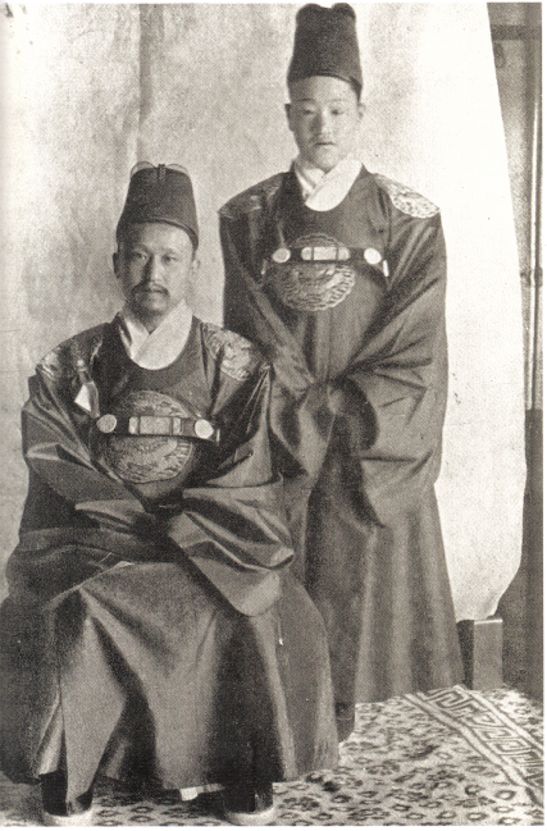
King Kojong and first emperor (Emperor Gwangmu) of the Korean Empire(1852-1919, r.1863-1907) and his son, Sunjong(1874-1926,r. 1907-1910 Emperor Yung-hui) in 1890. Kojong was forced to abdicate in 1907 by the Japanese after trying to assert Korean sovereignty at the Hague Peace Convention of 1907.Kojong's death in 1919 sparked massive independence demonstrations in Korea as it was suspected that had been poisoned by the Japanese.Most western countries supported Japan's protectorate of Korea. Sojung was to the last emperor of the Choson Dynasty. After the Japanese annexation of 1910, Sunjong was confined to the Changdoek Palace. He had no children.
newsreel of King Sonjong's funeral in 1926
Emperor Sunjong(Korean; 순종) or Emperor Yung-Hui (Korean ; 융희제; Chinese Character ; 隆熙帝)(March 25, 1874 -- April 24, 1926) was the last emperor of the Joseon Dynasty and Korean Empire in Korea, ruling from 1907 until 1910. His Birthname was Cheok Yi (Korean; 이척, Chinese Character; 李拓) He is the fourth son of Emperor Gojong (Emperor Gwangmu). He became Crown Prince of Joseon Dynasty in 1878, and became the 27th Sovereign of Joseon Dynasty as 'Emperor Yung-Hui' when the Japanese forced the abdication of Emperor Gojong in 1907. His short reign ended with the Japan-Korea Annexation Treaty of 1910. After Annexation Treaty, he was put in the Changdeokgung Palace for confinement by the Japanese Government. He died on April 24, 1926 in Changdeokgung Palace. This film was taken in May 7th, 1926, when the funeral was took place. This footage may be a excerpt from a presumed-lost Korean documentary film, "The Funeral of His Imperial Majesty Emperor Sunjong"(Released in 1928), but this is still in dispute. The footage was edited in 1959, adding some narration and Gayagum(A Korean string instrument)music soundtrack. In 1897, King Kojong changed his reign name to ' Kwangmu' "Martial Brillance' and in October he proclaimed the ' Great Han empire.' This was due in a large part to the public outrage of his having been hiding in the Russian legation since the assassination of Queen Min and the activities of the Korean Independence Club. He proclaimed the empire from the Gyeongungung Palace, which was close to the protection of the British, Russian and American legations .He tried to promote the Gwangmu Reform to modernize the land ownership through a modern survey of the country,monetary reforms. The Seoul electric Company was formed and an electric street system was started. In 1902 the first telephone line was installed in Korea. Modern schools were started and a textile industry promoted. However, the military was not modernized, a fatal flaw.
streetcars in Seoul in the 1890s
silver half won of the Great Han Empire, 1907 This effectively severed Korea's historic ties to the Qing Chinese tradition which Korea had adhered to since the fall of the Ming Dynasty, and turning King Gojong into the Gwangmu Emperor.In September 1905 Russia and Japan signed the Treaty of Portsmouth ending the Russo-Japanese War and firmly establishing Japan's consolidation of influence on Korea. Secret diplomatic contacts were sent by the Gwangmu Emperor in the fall of 1905 to outside of Korea because presenting Korea's desperate case to preserve their sovereignty through normal diplomatic channels was no longer an option due to the constant surveillance by the Japanese. On November 17, 1905 the Eulsa Treaty was signed in Korea . the Gwangmu Emperor was forced to abdicate in 1907 in favor of his son, King Sunjong, who became the Yunghui Emperor (the second and last emperor of the Empire of Korea), due his attempt to send delegates to the Hague Peace Conference (Hague Convention of 1907) in violation of the arbitrarily implemented Eulsa Treaty. The delegation at The Hague was led by Yi Sang-seol and his deputy Yi Jun presented a diplomatic attempt to reclaim the Empire's sovereignty. Although Korea pleaded its case to the powerful members of colonial elite nations at The Hague, the view of protectorate status of Japan over Korea seemed natural and beneficial at the height of colonialism in the first decade of the twentieth century.Reportedly, the Korean Foreign Minister's seal was snatched and pressed on the document which had been prepared by the Japanese. One week after the forced "treaty" the State Department withdrew its US legation from Korea even before Korea notified the US of their new "protectorate" status on August 22, 1910, the Empire of Korea was annexed by Japan with the Japan-Korea Annexation Treaty, beginning a 35-year period of Japanese rule.
Famous photograph of one of the' righteous armies', (uibyong 의병). For at least 13 years after 1905, small irregular forces, often led by former regular army commanders, fought skirmishes and battles throughout Korea against Japanese forces. Many Koreans also collaborated with the Japanese and half of the police force that fought the Independence fighters were Koreans. In North Korea, those suspected of collaboration with the Japanese and their families face were executed, imprisoned and their families face discrimination today. In South Korea there have been few trials of collaborators. Japan, China, and Russia had vied for influence over Korea from the late 1800s. With China out of the way, and the policies of Korea largely in her favor, all Japan had to do was eliminate Russia. Russia had economic interests in Korea and Manchuria that it hoped to exploit. It also had influence at the Korean court in the last years of the 1890s. When Japan and the Western powers sent troops into China in 1900 to subdue the Boxer Rebellion, Russia moved troops into Manchuria. Early in the 1900s, Russia completed the Trans-Siberian railway, which enabled easy movement of men and supplies to the Far East. Japan thought of this as too provocative and, using Korea as a conduit to Manchuria, attacked the Russians. Fought partially within Korean territory and partially on Japanese-occupied Chinese soil, the Russo-Japanese War (1904-1905) was the first major conflict between East and West. To the surprise of many in the West, Japan handily defeated the Russians and forced Western nations to look upon it as a world power. Infrastructure projects started during the late Chosun Dynasty (1880-1905) by Western nations and Japan: 1) First rail lines built: connect Pusan to Seoul and Oiju; also Seoul to Inch'on. 2) First telegraph lines laid: connect Pusan to Inch'on and Oiju. 3) King Kojong makes the country's first telephone call. 4) First electricity and public water service installed in Seoul. 5) First hospital constructed, later to become Severance Hospital. 6) First Western-style schools: built by missionaries for bothmales and females of all social classes. 7) First hotel built in Seoul: Chosun Hotel.
|
||||
|
The samurai invasion |
||||