
Koguryo-Japan conflict

Gwanggaeto or Kwanggaet'o Stele in Jian, China
The era of Koguryo-Japan conflicts is monumentalized by the Monument of King Kwanggaet'o, which iooms up outside the T'ung-kou County along the Yalu River, where an ancient capital of Koguryo was located. The Monument was built in 414 A.D., two years after the death of the King.
The existence of the monument has been known to the Korean people for five centuries. But it was only about 80 years ago that the epitaph on the monument was deciphered and studied by Japanese and Chinese scholars. The decoding of the epitaph gave important clues to the study of the Korean Peninsula's ancient history.
The epitaph, describing the life history of King Kwanggaet'o, dealt largely with the king's "down to the South" expansion policy, and therefore touched on the struggle between Koguryo ana Japan. The king acceded to the throne at the age of eighteen in 391 A.D. and reigned the country for 22 years.
During his regime, the king successfully prevented the invasion of Yen forces from Liao-tung in the north and at the same time sent his army to the south to fight back the Japanese troops. The epitaph of the monument shows that the king sent his troops four times to the south-in 396 A.D. for an expedition to Paekche, in 399 A.D. to demonstrate his military strength in the south, in 400 A.D. to help SiIla and in 404 A.D. to have a naval battle with Japan.
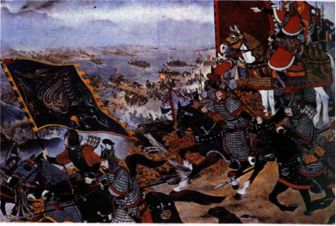
King Kwanggaet'o in battle
The epitaph says that the king's first expedition to Paekche was indirectly aimed at driving the Japanese power behind Paekche out of the peninsula. The king brought his powerful naval forces to Paekche and took some 50 Paekche castles. When his forces approached the Paekche Metropolis after crossing the Han River, Paekche King surrendered. The second expedition to the south was to punish Paekche, which had maintained friendly relations with Japan in breach of its agreement with the king. During this expedition, Shilla sent an envoy to the king's camp asking the king's help to get rid of the Japanese forces that had occupied Shilla atthat time. Thus, the third expedition to the south. This time, the king led 50,000 soldiers to enter Shilla and reached Kara, pursuing Japanese troops. The naval battlein 404 A.D. took place in the Tai-fang border on the west coast of the Central Peninsula which is believed to be off Inch'on Bay .That all these four expeditions had something to do with the Japanese forces shows how far Japanese power had reached in the peninsula at that time. Two most significant results of these expeditions were that the relationship between Koguryo and Shilla was improved radically and that Paekche lost its power in the Han River area, which caused the country to move its capital to the south. King Changsu, who succeeded King Kwanggaet'o, was on the throne for 79 years as his name (king longevity) indicates. He followed King Kwanggaet'o's policy and promoted the "Expansion to the South" project positively. The removal of the capital from Wan-tu to P'yongyang in 427 A.D. was highly significant in the process of the expansion-to-thesouth-policy.