|
Korean War June 25, 1950 – July 27, 1953
Crowd at Seoul Station the day after the Japanese surrender
The American occupation started on Sept 8, 1945 with a landing at Inchon. Japanese troops were used as police in the American and Soviet occupied zones after the war. A Japanese officer with a samurai sword acts as an interpreter.
Koreans returning from Manchuria via Tianjin on an American troop carrier. At the Cairo Conference of 1943, the leaders of the United States, Great Britain, and China declared that "mindful of the enslavement of the people of Korea, (we) are determined that in due course Korea shall become free and independent." The Soviet Union agreed to it in 1945. Later that year at the Yalta Conference, it was decided to split the Korean Peninsula at the 38th parallel to effect the surrender of Japanese troops south of the parallel by the U.S. army and north of it by the Soviet army. Later, a joint trusteeship of Korea by the U.S., Soviet Union, Great Britain, and China was proposed, on the premise that the Koreans lacked the mechanisms and political sophistication to govern themselves. Although the surrender of the Japanese army was carried out as planned, the trusteeship was never implemented.
Voter in Korea's first national election, 1948. The UN set up the election, but Soviet and North Korean officials refused to allow UN representatives into northern territory, as a result, elections took place only in the South.
Korean War in Color
A demonstration before the 1948 UN election in Seoul..
Video on the Jeju uprising and Sunchon Rebellion (1948-1949)- 제주 4·3 민중항쟁 (April 3, 1948), on Jeju Island. An estimated 14,~30,000 were estimated to have been killed in factional fighting and police activity. This rebellion consumed much of the South Korean army's attention before the outbreak of the Korean War. A massive purge of the South Korean army in the aftermath greatly weakened the South's military prior to the outbreak of war with the North .
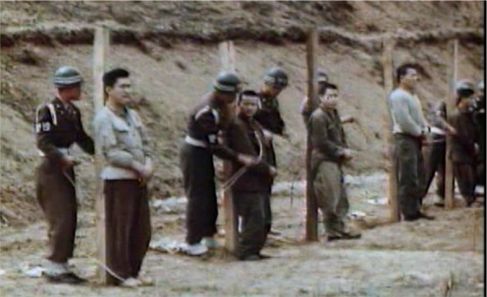
North Korean infiltrators about to be executed by South Korean military police in 1950. Both sides sent infiltrators into the other's territory to try to destabilize their opponents .
Defeat in WW II ended Japan's 36-year occupation of Korea, but it did not, to the extreme regret of the Koreans, fulfill their hope of achieving immediate independence. U.S. and Soviet military governments were established in their respective sectors of the peninsula until countrywide elections could be held and a Korean government instituted.General Ivan M Chistiakov led the 25 Division which occupied Korea north of the 38th parallel.
1947 Korean Won
The artificial split of the country-never meant to be a political or permanent measure-and its control by foreign powers precluded Korean say in what happened to the peninsula immediately after the Japanese departure. The U.S. military government concerned itself primarily with immediate stability and basically carrying on the administration set up by the Japanese, while the Soviets were probably more farsighted in their goal of establishing a government in their own image. Split in two, the north was primarily industrial and the south agricultural. Neither sector was self-sufficient, so both were infused with economic aid. A joint U.S.-Soviet commission on Korea met in 1946 (P'yongyang) and 1947 (Seoul) to discuss what was to become of this orphaned country. No agreement on unification could be reached, and talks were not resumed.
Seoul before the war In 1946, the Provisional People's Committee for North Korea was established under Soviet auspices as an interim government; the following year it was renamed the People's Committee of North Korea. In 1947, the South Korean Interim Legislative Assembly was formed as a provisional government under the supervision of the United Nations. That same year, the U.N. General Assembly resolved to conduct supervised elections on the peninsula. The Soviets, however, would not permit election officials into their half, so in May 1948 elections were held only in the south. The first National Assembly convened in May and the constitution was adopted in July, followed three days later by the election of Syngman Rhee as president. On 15 August 1948 the Republic of Korea (Taehan Minguk) was officially founded, recognized by the U.N. as the only legitimate government of all Korea. The following month, with the blessing of the Soviet Union, North Koreans formally set up their own government in P'yongyang. Headed by Kim II-song (and under his control until his death in 1994) it was named the Democratic People's Republic of Korea. Kim Il song (born as Kim Song ju, later changed his name to Il Sung meaning 'of the sun.' It may have been the name of another guerrilla fighter )Kim was 33 years old at the time,had fought the Japanese and spent the last years of the war in Soviet training camps. Kim became a Captain in the Soviet Red Army and served in it until the end of World War II.Kim Il Sung was handpicked by Stalin to lead North Korea over a number of other possible contenders, including Pak Hon-Yong, an ardent Communist whom Kim later purged.Both sides claimed to be the sole legitimate government of the Korean people, and each said it would fight to regain control of the whole country. By 1950 North Korea had a 120,000 man army while the South had about 60,000.
Ceremony at the capital at the founding of the Republic of Korea on August 15, 1948 By mid-1949 U.S. troops were withdrawn from the southern half-Russian troops having already left the north-with only a small contingent left as military advisers to the fledgling South Korean army. North Korea, with aid from both Russia and China, was able to rebuild its industrial base and create an effective military organization more quickly than the south. In the meantime the North had built a strong political and military structure with Soviet help . All left wing groups were merged into the Korean Worker's Party in August 1946 . Between 1946 to 1949, great numbers of North Korean young men, roughly 10,000, were taken to the Soviet Union for military training .A draft was instituted . In 1949 40,000battle hardened troops of the former Korean Volunteer Army in China who had fought in the recent Chinese Civil War ( 1945-49) returned to North Korea . By June 1950, The North Korean Armed forces were estimated to number 150,000 to 200,000 troops in 10 infantry divisions, one tank division with formidable T34 tanks, one air force division with Yak fighters. Pitted against this the South Korean Army had an estimated 60,000 to 70,000 men, no tanks, heavy artillery or combat airplanes .
Weapons of Victory 19 - Yakovlev Yak 9 fighter
Three important factors, then, led to the civil war the world knows as the Korean War: the North Korean military was much better equipped, there was strong sentiment to unite the land, and U.S. Secretary of State Acheson publicly stated (mid June 1950) that the Korean Peninsula was out of the U.S. perimeter of defense in Asia. Korean War
Opening phases of the Korea War
North Korean soldier with an Inmun gun
Painting of Kim Il sung directing anti-aircraft guns. Kim did lead troops in battle during the war and was wounded.
A ROK soldier Heavily armed and led by a phalanx of tanks, the Soviet-trained and -equipped North Korean army crossed the 38th parallel in the early morning of 25 June 1950 and invaded South Korea. War was on. Prior to the invasion, periodic conflict occurred along the border; neither side seems blameless in its provocation of the other, and each added to the tension, distrust, and climate of uncertainty.
Into the Fire Korean movie The film is based on a true story of a group of 71 undertrained and underarmed, outgunned student-soldiers of South Korea during the Korean War, who were mostly killed on August 11, 1950, during the Battle of P'ohang-dong. For 11 hours, they defended P'ohang-dong girls' middle school, a strategic point for safeguarding the Nakdong River, from an attack by overwhelming North Korean forces, the 766th Unit. Watch trailer .
The Korean War: Every Day Good way to visualize the Korean War and see how close North Korea came to winning the war . As this border was an artificial creation of foreign powers, the North Koreans denied it was an invasion, insisting their action was meant to reclaim what was rightfully theirs. South Korea naturally saw this differently, but its poorly armed military was no match for North Korean troops. Within days Seoul fell; preceded by fleeing citizens, South Korean troops made a strategic retreat. A special session of the United Nations approved U.N. intercession (the Soviet Union-which would have vetoed the action was boycotting U.N. sessions for other reasons).
Mig-15 Soviet Korean War fighter The artificial split of the country-never meant to be a political or permanent measure-and its control by foreign powers precluded Korean say in what happened to the peninsula immediately after the Japanese departure. The U.S. military government concerned itself primarily with immediate stability and basically carrying on the administration set up by the Japanese, while the Soviets were probably more farsighted in their goal of establishing a government in their own image. Split in two, the north was primarily industrial and the south agricultural. Neither sector was self-sufficient, so both were infused with economic aid. A joint U.S.-Soviet commission on Korea met in 1946 (P'yongyang) and 1947 (Seoul) to discuss what was to become of this orphaned country. No agreement on unification could be reached, and talks were not resumed. Fifty-three U.N. member nations gave weapons, medical supplies, backup support, and money to South Korea; 16 countries provided troops. By far the largest supplier of troops and armaments was the U.S., whose commanding officer was military commander of all U.N. operations.
The smaller South Korean army and remaining US troops were quickly overwhelmed by the larger North Korean Army North Korean troops continued to push south until September, when they were stopped by South Korean and U.N. troops at what became known as the Pusan Perimeter, a line of defense that ran north from Masan, up and around Taegu, and over to a point south of P'ohang. This southeastern corner of the country was the only area never overrun by North Korean troops. In September, General Douglas MacArthur gambled on an amphibious invasion at Inch'on and a concurrent movement of troops up the east coast to break North Korean supply lines to the south. The now famous Inch'on landing seemed a harebrained idea, so preposterous that most military leaders argued heavily against it, yet it went like clockwork and was a resounding success. Troops defending the Pusan Perimeter were able to break out, capture thousands of North Koreans, and push into North Korea. By November nearly all of North Korean territory had been taken and some U.N. troops were at the Amnok (Yalu) River. Fearful that U.N. forces would cross into Chinese territory as Gen. MacArthur had urged, the newly established People's Republic of China sent troops to help the flagging North Korean army. With this horde of humanity crushing against them, the U.N. troops were forced back. Much of the heaviest fighting of the war took place that winter in the cold northern mountain regions; the U.N. troops suffered some of their most devastating defeats and highest casualty rates.
The Chinese forces were well camouflaged, which led to their strength being greatly underestimated by US spotter planes before they entered Korea.
Chinese forces with old Imperial Japanese tanks in 1951
North Korean leader Kim Il sung signing the armistice. Once the Chinese invaded, they took complete control of the war. There are no monuments or mention of Chinese involvement in North Korea today.
Intense American bombing lead to the North Koreans building underground factories Korean War map late 1950 to 1953 By spring 1951, this conflict came to a stalemate at roughly the 38th parallel. On 23 June, the U.N. Security Council president, the Soviet delegate, proposed a cease-fire. Negotiations began on 10 June at Kaesong, in territory held by North Koreans. After a brief renewal of hostilities, negotiations resumed at P'anmunjom. During these talks, both sides increased their strength, consolidated their positions, and dug in; several devastating battle also took place, including the infamous Heartbreak Ridge, Punch Bowl, and Porkchop Hill. Cease-fire negotiations continued until 27 July 1953, when an armistice was agreed on.
UN forces retreating from North Korea surrounded by Chinese and North Korean forces in the bitter retreat from the Choson reservoir
Chinese troops with American .30 caliber Browning machine guns. The Chinese were stocked with American arms after the defeat of Chiang Kai-shek in the Chinese Civil War.
Mao and his favorite son, Anying, who was killed by American bombing fighting in Korea.
The Chosin Reservoir Campaign: Frozen Chosin In the winter of 1950, deep within the frozen mountains of North Korea, 15,000 U.S. Soldiers and Marines were surrounded and trapped by 120,000 Chinese soldiers. Despite the odds, the Marines refused to surrender and fought their way 78 miles to the sea and rescued 98,000 refugees. Signed by the heads of the U.N., North Korean, and Chinese armies, the armistice was only a military agreement that formally ended the hostilities. President Syngman Rhee refused to sign, and South Korea has never been a signatory. The agreement provided for a cease fire line (drawn roughly along the last point of contact between the opposing forces, representing the de facto border between the two countries) flanked by a four-km-wide Demilitarized Zone (DMZ), and a bureaucratic structure to implement the armistice. It was not a peace agreement, and there has never been a political or diplomatic solution to this festering problem. However, such talks have taken place periodically since then. In 1954, negotiations were started in Geneva but quickly broke down. Secret negotiations were held in 1972, and public talks have been conducted several times during the '80s and '90s, with few real results.
MacArthur could not cope with the sudden influx of large number of Chinese troops and wanted to use atomic weapons on North Korea and China. Truman, fearing this would lead to World War III, replaced him with Gen. Ridgeway, who developed a 'meat grinder method to deal with the Chinese and North Korean numerical advantage. Neither faction won this fratricidal war. Destruction of the infrastructures of both countries was massive, and it's estimated that over a million people died and millions more were displaced. Figures for internal migration during the war estimate that two million people moved fromNorth to South while a significantly lower number went in the opposite direction. The war left untold resentment on both sides, a twisted view of the sponsoring foreign nations, and deep psychological wounds. A siege mentality has permeated the South Korean government since the war, characterized by strident anti-communism, distrust of anything across the border, and an unbending military stance. Another reality of life in this formerly undivided nation is that the artificial border has proved to be even less porous than the Berlin Wall. Virtually no contact has taken place between people of the South and North; propaganda is rampant and misconceptions are pervasive. A U.S.-South Korea Mutual Defense Pact was negotiated in 1953 and a treaty of friendship, commerce, and navigation was signed in 1956. Kim Il song himself led troops in the field.
Fighting in Seoul
North Korean and U.S. soldiers fraternizing on the day after the armistice, July 28, 1953. The total number of people killed in the war is estimated to be from 3~4 million. An estimated 2 million North Korean civilians were killed and about 500,000 North Korean soldiers. An estimated 1 million Chinese soldiers were killed. South Korean civilian deaths are estimated at 1 million. The U.S. deaths were 54,246 with about 3,194 among other forces. 686 of these were British.
Signing of the Korean War Armistice
1,000 Won bill from 1950, Syngman Rhee. Toward the end of the Korean War the won was devaluated at 6000 won = 1 dollar.
They chose China. The story of 21 American POWS who decided to stay in China after the war. Watch here . January 1954. The Korean War is over. Captured UN soldiers held in POW camps are free to return home. Those who refuse repatriation to their homeland are transferred to a neutral zone and given 90 days to reconsider their decision. Among them are 21 American soldiers who decide defiantly to stay in China. Back in the United States, McCarthyism is at its height. Many Americans believe these young men have been brainwashed by Chinese communists through a new form of thought control. But what really happened? Featuring never-before-seen footage from the Chinese camps as well as interviews with former POWs and their families, They Chose China tells the fascinating stories of these forgotten American dissidents. With the Cold War fading into memory, Oscar-nominated filmmaker Shuibo Wang (Sunrise Over Tiananmen Square) aims his camera on this astonishing story. Famous American veterans of the Korean War
John Glenn,Ted Williams, Willie Nelson,James Baker,Charles Rangel, Alan Alda (post war service) Russian involvement in the Korean War The Soviets trained and equipped Kim Il sung's army and provided arms to the Chinese, but did not send troops to fight in the ground war as the Chinese. The Soviets did provide MiG pilots, advisors,radar operators, and anti-aircraft gunners . The Soviet advisory of the North Korea Army staff prepared the assault plan for the attack on South Korea. It is rumoured that Stalin promised Mao air support and ground troops, and when these didn't materialize helped led to the Sino-Soviet split. The cannon-equipped MiG 15s Soviet jet could fly higher and faster than even the Sabre jets and proved very effective at destroying the slow moving U.S. B-29s, forcing the B-29s to leave the 'Mig Alley' corridor on the Sino-Korean border. The Soviets provided about 5,000 airmen to the North Koreans during the war, shooting down an estimated 1,300 American aircraft. According to US intelligence estimates Soviet Union introduced about 25,000 troops into North Korea only after the front had stabilized, and they did not participate in fighting on the front line.16 Soviet pilots became aces, with Evgeni Pepelyaev having the most with 23 kills, higher than the top American ace. The Forgettable '50s
Demonstration by professors supporting the student Revolution of 1960 As part of its response to possible aggression from North Korea the United States Army deployed missiles throughout South Korea, and by late 1958 the Army's 280mm atomic cannon had also been deployed as a show of America's military might. Following North Korea’s most recent nuclear test on February 12th, 2013 conservative officials in the South have resumed calls for the return of U.S. tactical nuclear weapons to the peninsula. U.S. tactical nuclear weapons were withdrawn from the Korean peninsula in late 1991 as part of President George H.W. Bush’s Presidential Nuclear Initiative . South Korea suffered serious economic stagnation after the war. As an agricultural country, it was able to start producing food again at a reasonable rate, but because most of the heavy industry and a great deal of natural resources were in the north, it had to build its industrial base virtually from scratch and rely upon foreign sources for raw materials. Despite large amounts of aid, development came slowly. Most businesses were still small-scale, and the few large industries were concentrated in the hands of a few wealthy families with the right connections in government. President Rhee had been elected by the National Assembly in 1948, but in 1952, following a martial law proclamation in which many opposition leaders were jailed, the law was changed to permit presidential election by popular vote (to better ensure Rhee's reelection). In 1956, over muted opposition, a constitutional amendment was railroaded through the Assembly that allowed the president an unlimited number of terms. With little to show for his time in office and an increasingly authoritarian style, President Rhee's popularity dwindled. During the election of 1960, fraud was so rampant, party politics so corrupt, the economy so bad, and Rhee's rule so despotic that the majority of the people wanted him out. Students demonstrated in late February and early March. In mid-April, the discovery of the body of a student demonstrator in Masan Bay sparked renewed demonstrations that even brought university professors out into the street. On 26 April, a bitter President Rhee resigned, and left for self-exile in Hawaii, where he died nine years later at the age of 89. His regime, downfall, and exile (courtesy of the U.S. government) are very similar to that of former President Ferdinand Marcos of the Philippines. After four months of interim government led by Ho Chong, Yun Po-sun was elected the next president. Under the new parliamentary system, however, the real power resided in the prime minister, Chang Myon. More liberal than the previous government, Chang's eased political restrictions. While formulated with good intentions, this coalition of inexperienced leaders with weak personal power bases was not able to control the deteriorating economy, the fractured political situation, and continued student demonstrations. The parliamentary government ended nine months later in a bloodless military coup.
|
||||