|
Koryo or Goryeo Dynasty 고려국 高麗 918 - 1392
With the unification of the country under Koryo control, the capital was moved from Kumsong (Kyongju) to Songdo (Kaesong). The Koryo Dynasty (918-1392) took its name from Koguryo, and from it comes the English name Korea. Government was completely restructured, agricultural reforms were made, a new educational system was initiated, and diplomatic relations were strengthened with China, ushering in a 200-year period of relative peace and prosperity. Power was centralized in the king, and the administration was carried out by bureaucrats and scholars who had achieved their position by examination, not birth. Unlike United Shilla's government, where power was "tribal," the Koryo system involved people from the whole peninsula and helped to create a unified national identity. Regional capitals were established, administered by appointed bureaucrats to check any possible emergence of a power base within the local gentry.
Goryeo was established in 918. And they had trades with even Europeans through arabian merchants. Trade with Goryeo gave Korea its name to the western world. Goryeo is famous for its Printing technology and Pottery.
Koryo's celadon ware developed under the influence of Sung Yuan dynasty ceramics, first produced around 1050. Most famous for the green pisaek 'secret color' glaze
video on Goryeo celadons Rank and land became power and wealth, and this new bureaucratic social class eventually became hereditary. Increased interest in education led to the establishment of a national university and local schools. Although Confucianism continued to be important in politics, ethics, and daily affairs, Buddhism remained the primary spiritual inspiration and focus of religious fulfillment through the end of the dynasty. Land was given to Buddhist temples and monasteries, and certain Buddhist monks became involved in the mechanisms of power. At this time, the son (Zen) sect of Buddhism became the predominant order. Much of Koryo's art was religious in content; its most significant contribution, however, was the production of celadon, perhaps the best in the world. Other achievements of the dynasty were elegant wooden structures, literary histories, cast-metal movable type (created in 1234-200 years before Gutenberg), and the production of gunpowder.
King Taejo 877-943
Wang Geon, who became King Taejo ( 877- 943, r. 918-943), was the founder of the Goryeo Dynasty. In the later years of Shilla, in the Later Three Kingdoms period (892 - 936), consisting of Shilla, Hubaekje ("Later Baekje"), and Taebong (also known as Hugoguryeo, "Later Goguryeo") many local leaders and bandits rebelled against the rule of Queen Jinsung. Taebong, originally led by Gung Ye, was taken over by Wang Geon, a descendant of a merchant family of Songdo, who defeated Hubaekje and received the surrender of Shilla. Wang Geon proclaimed the kingdom of Goryeo in 936, officially putting an end to the Later Three Kingdoms period. the unification of 668 by Shilla was completed in only half of the nation, since the northern part was ruled by Balhae, the revival of Goguryeo. However, Wang's unification in 936 was a total unification of the peninsula .
The Architectural Story of Gyeongbok Palace (경복궁) is the primary palace that was built by King Taejo when he founded the city of Seoul in the late 14th century.
Maitreya, Buddha of the Future (18m high), Kwanch'oksa Temple, Nonsan, built in 968 Gwangjong (949-975) Gwangjong was a reformer. In order to strengthen the power of the central government, Gwangjong, the 4th King in the lineage and of the kingdom, first, made laws to emancipate slaves (노비안검법, 奴婢按檢法) in 958, and one creating the national civil service examinations. Gwangjong a key figure in establishing Confucianism.
Koryo pagoda in the Koryo capital of Songdo ( 松都) modern day Kaesong
Khitan invasions (993 - 1019)
In 993, the Khitan invaded Koryo's (Goryeo's) northwest border with an estimated 800,000 troops. The Khitan withdrew and ceded territory to the east of the Amnok River when Goryeo agreed to end its alliance with Song China. However, Goryeo continued to communicate with Song, having strengthened its position by building a fortress in the newly gained northern territories. Meanwhile, In 1009, General Gang Jo of Goryeo led a coup against King Mokjong, killing the king and establishing military rule. In 1010, The Khitan attacked again with 400,000 troops during an internal Goryeo power struggle. Gang Jo blocked the Liao invasions until his own death. The Koryo (Goryeo) King Hyeonjong was forced to flee the capital to Naju temporarily. Unable to establish a foothold and fearing a counterattack, the Khitan forces withdrew. In 1018, Khitan army invaded for the third time with 100,000 troops. In Heunghaejin stream, General Gang Gamchan ordered the stream to be blocked until the Khitans began to cross it, and when the Khitans were mid-way across, he ordered that the dam be destroyed so that the water would drown much of the Khitan army. The damage was great, and General Gang led a massive attack that annihilated many of the Khitan army. Barely a few thousand of the Liao troops survived after the bitter defeat at Kwiju one year later. Early in the dynasty, additional territory had been added in the north, and Cheju-do was annexed in 1105. For a tighter defense, by 1044 a wall had been constructed across the peninsula -reminiscent of the Great Wall of China-from the mouth of the Amnok (Yalu) River to Hamhung. Civilian control ended in 1170, following a military coup that reduced the king to a figurehead. Power was concentrated in the Ch'oe family, whose head became a virtual dictator. Private armies were established, including the sambyolch'o, an ultra-nationalistic elite force loyal to the Ch'oes. This period saw harsh infighting and economic deterioration. It became obvious that the military was incapable of running the government properly, so civilian bureaucrats were soon reincorporated in large numbers. The Mongol invasions (1231 - 1273)
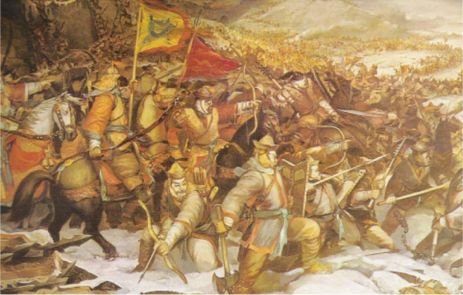
Koryo's General Kang Kam-chan battling Mongolians Gojong of Koryo (Goryeo) (reigned 1213-1259) was the twenty-third king of the Goryeo dynasty. In 1225, the Mongol Empire demanded tribute from Koryo (Goryeo), but Goryeo refused, and the Mongol envoy Chu-ku-yu was killed. His death was used as an excuse to invade Koryo (Goryeo). In 1231, the Mongols invaded Koryo territory, taking the capital. The royalty fled to the island of Kanghwa-do, where it set up a government in internal exile. Although unable to capture the island, the Mongols controlled the rest of the peninsula as a vassal state. The Koryo king ordered the Koreana Tripitaka, a collection of more than 80,000 hand-carved wooden printing blocks of the entire Buddhist canon, be produced as a supplication to Buddha for aid in resisting the Mongols. (The Mongols remained for a century, but the printing blocks have survived until today and are kept at Haein-sa in Kyongsangnam-Do.) Resistance to the invaders was led by the military, but when the Mongols laid waste the country, resulting in incredible hardship for the common people, opposition dissipated. Finally, the king sued for peace and returned to his rightful throne in 1270. The sambyolch'o, however, was not content with this settlement. This elite force struggled against a combined Silla/Mongol army, first setting up a small maritime kingdom on Chin-do, later being pushed south to Cheju-do where they finally met defeat in 1273.
In 1280 the Mongols took the dynastic name Yuan, and for the next century they ruled China with a strict hand, greatly influencing Koryo. Strong and independent before the Mongol invasions, Koryo became a tribute state afterward. Korean kings had little say in domestic or foreign affairs, and forced intermarriage reduced the royal family to a branch of the Mongol royal family. One of the dramatic consequences of this partnership was Koryo aid to the Mongol invasions of Japan in 1281, which led to untold human suffering and the destruction of the Koryo/Mongol military force in a typhoon. The Military Regime's Resistance Against the Mongols The Mongols arose as a nomadic herding people in the steppe region of north central Asia. The wealth produced by the agricultural peoples to their south naturally aroused their acquisitive instincts, and so it was that the empires of Chin and Sung, and Koryo too, became prime targets of Mongol invasion. After defeating Chin there was a further reason for the Mongols to extend the swath of their conquests to Koryo-the objective of securing a base for the subjugation of the Southern Sung and Japan. The first contact between Koryo and the Mongols resulted from their joint effort to destroy a motley army of Khitan who had fled from Manchuria across the Yalu to escape the Mongols. When Chin came under sustained Mongol attack, the Khitan had taken the opportunity to assert their independence, but following the fall of the Chin capital in 1215, Mongol pressure drove the Khitan into Koryo territory. After creating considerable turmoil in Koryo's northern regions for more than two years, the Khitan made a defensive stand at Kangdong Fortress, east of Pyongyang, but soon were compelled to surrender by the combined Mongol-Koryo siege forces (1219). After this incident the Mongols regarded themselves as Koryo's benefactors and came to collect annual tribute. Their demands were too heavy, however, and on several occasions Koryo refused to accede to them. This was the immediate cause for the beginning of a rift between the two. Subsequently, in 1225, the Mongol envoy Chuku-yi was killed enroute back from Koryo, and the Mongols eventually used the incident as a pretext for launching their first invasion of Koryo, in 1231. The Mongol army led by Sartaq ran into stubborn resistance from Pak So at Kuju (Kusong) but, abandoning his siege there, Sartaq drove toward the capital at Kaesong. When Koryo now sued for peace, the Mongols left military governors (daruhaci) behind in the northwest region of Korea and withdrew their troops. But Ch'oe U resolved to resist the Mongols and so moved the capital to Kanghwa Island the next year (1232), an action calculated to exploit the one Mongol weakness, their fear of the sea. At the same time that the ruling class entered Kanghwa, the populace in general was made to take refuge in the mountain fortresses or on islands off the coast. Koryo's decision to resist the Mongols provoked further invasions. To be sure, the Mongol force again withdrew upon the death of their commander, Sartaq, at the hands of the monk Kim Yun-hu in the battle at Ch'oin-song (Yongin), later in 1232, but thereafter Mongol assaults continued as before. In the end, over a thirty year period, the Mongols launched a total of six invasions of Koryo. To one standing on a hill on the mainland opposite, the shoreline of Kanghwa Island lies visible just across the water. Nevertheless, the Mongols could only glare across this narrow strip of sea and call to the Koryo defenders to come out onto the mainland. The Koryo response was that they would come out, if the Mongols first withdrew their forces. To which the Mongols in turn rejoined that they would withdraw, if first the Koreans came back across to the mainland. It was a pointless exchange of verbal taunts, for the real question was the strength of will on the part of the Ch'oe house to continue to resist. So long as their determination to resist could not be broken, it would be well-nigh impossible for the Mongols to capture Kanghwa. Meanwhile, secure in their haven on Kanghwa, the members of the ruling class were able to continue their extravagant lives of luxury no differently than they had in Kaesong. It was just as if they had moved intact to Kanghwa all the facilities of the capital-the palaces, mansions, temples, polo fields, everything. The merriment on the occasion of the great annual festivals, such as the p'algwanhoe and yondunghoe, also was the same. This was because the amount of the grain tax revenues as well, sent by ship along safe coastal routes, was little different than before. The Struggle of the People The resistance of the military regime to the Mongols at first was carried on with the support of the peasantry and the lowborn classes. At the time of the first Mongol invasion, the brigand bands on Mt. Kwanak gave themselves up and joined in the battle against the Mongol enemy. The resistance of the army of slaves at Ch'ungju, led by Chi Kwang-su, is particularly famous. They fought bravely to the end to defend the town, even though the aristocratic officials all had fled. While moving the capital to Kanghwa the military regime had instructed the peasantry to take refuge in mountain fortresses and on islands off the coast. These areas thus became the base points for the struggle against the Mongols. Unable to overcome the stout resistance of these redoubts, the Mongols adopted the tactic of laying waste by fire to the ripened grain fields. Food supplies then ran short, and because of this the peasantry suffered much hardship. Moreover, when a mountain fortress fell to the Mongols, the strength of its defenders exhausted, they were cruelly slaughtered by their conquerors. The most severe suffering and destruction resulted from the invasion led by Jalairtai in 1254. On this occasion it is said that the number of captives the Mongols took back with them reached more than 200,000, while the corpses of the dead were too many to be counted and the entire region through which the Mongols passed was reduced to ashes. The population thus declined and whole villages fell into ruin. It was also during this time that many irreplaceable cultural treasures were lost, outstanding among them the nine-story wooden pagoda at Hwangnyong-sa in Kyongju and the woodblocks for the Tripitaka produced two hundred years earlier and stored at the Puin-sa monastery in Taegu. As the villages became devastated, the life of the peasants inevitably became one of hardship. But the government on Kanghwa, instead of pressing ahead with positive measures to safeguard the peasantry, by constant harsh exactions only made its condition more miserable. Such exploitation by the aristocratic elite not only bred hostility toward their rulers in the hearts of the peasants, but also dampened their desire to fight against the Mongols. This alienation of the people could not but pose a grave threat to the government on Kanghwa. Collapse of the Military Regime and Peace with the Mongols
The Tripitaka Koreana, a Korean collection of the Tripitaka Buddhist scriptures, carved onto 81,340 wooden printing blocks during the Koryo dynasty for divine aid in repelling the Mongols .The Tripitaka Koreana was first carved in 1087 when Goryeo was invaded by the Khitan . It is the most complete and accurate extant collection of Buddhist treatises, laws, and scriptures The Ch'oe had carried on resistance against the Mongols with the backing of the peasantry, but now that their support had weakened, a grave crisis overtook the military regime. Whether or not this crisis could be overcome would determine whether or not the regime would survive. Its trust in the power of the Buddha led the government to undertake another woodblock carving of the Tripitaka, and the result was the so-called Koryo Tripitaka, famed for its exquisite artistry, that remains to this day at Haein-sa near Taegu. The government also offered up anxious prayers to the deities of heaven and earth. It was in such an atmosphere that sentiment for peace with the Mongols arose among the king and the civil officials in particular. It was observed above that once the Ch'oe had begun to make use of men of letters, the voices of the civil officeholders, who for some time had been completely ignored, more and more demanded to be heard. At the outset they had held opposing views with regard to moving the capital to Kanghwa, and even after the move they took every opportunity to urge peace. This policy of the civil officials to make peace with the Mongols was directly related to the question of the further expansion of their role in the governing process. That is, their aim was to attempt to curb the power of the military men by reaching an accommodation with the Mongols. In order to achieve this objective peace was necessary, but to bring about peace would necessitate the downfall of those who advocated continued resistance, the military rulers. Accordingly, the civil officials, in collusion with a segment of the military officials, had initiated a move toward overthrowing the Ch'oe house, a move toward peace. The last of the Ch'oe dictators, Ch'oe Vi, was assassinated by the civil official Yu Kyong and the military official Kim Chun in 1258. Authority thus reverted for the moment to the king and a decision to make peace with the Mongols was reached. In the next year, then, the crown prince (later King Wonjong) went to the Mongols and conveyed Koryo's desire for peace, and to clearly signal this intent to cease resisting, Kanghwa's walled fortifications were torn down. The military men, however, still were not happy about peace with the Mongols. Although Kim Chun went along with the current of opinion around him, taking no active steps to thwart those working for peace, hl' nevertheless was not enthusiastic about the peace policy. Then, when Yon killed Kim Chun and seized power from him, the opposition to making peace came out into the open. In the end, 1m Yon went so far as to depose the king, Wonjong, who had put the pro-Mongol policy into effect. These events suggest that an inseparable linkage had formed between the pursuit of a policy of resistance to the Mongols and the perpetuation of military rule. time national solidarity had so disintegrated that the populace no longer could be rallied behind a policy of resistance. Mongol pressure soon restored Wonjong to the throne, and at his request Mongol troops were brought in. Under these circumstances, with the assassination by royal command of Yu-mu (Yon's son) who took power after his father's death), the flickering pulse of military rule that had been sustained since the downfall of the Ch'oe house now was utterly extinguished. This was the same year (1270) in which Koryo returned the capital to Kaesong and completely abandoned the struggle against the Mongols.
Anti-Mongol Struggle of the Sambyolch'o As already noted, the Three Elite patrols (Sambyolch'o) had constituted the military underpinning of military rule. They were also in the forefront of the struggle against the Mongols, bedeviling the enemy forces with their sudden forays and harrying tactics. The Three Elite Patrols, then, were the mainstay of military rule, the core force in the resistance against the Mongols. Accordingly, when the military regime was toppled and peace terms worked out with the Mongols, they were bitterly resentful. When the return to Kaesong was announced, therefore, the Three Elite Patrols immediately rose in revolt. Under the leadership of Pae Chung-son, they first blocked all transit between Kanghwa and the mainland. A royal kinsman, Wang On, the Marquis of Sunghwa, was put forward as king, a government was established, and officials were appointed, thus creating an anti-Mongol regime in opposition to the government at Kaesong. Kanghwa Island, to be sure, was the base from which the struggle with the Mongols had been waged for more than forty years. But the situation was different now that Wonjong's government at Kaesong was working hand in hand with the Mongols. It was necessary for the Three Elite Patrols to secure a permanent base of operations out of reach of the Kaesong government. The rebels went south, therefore, to the island of Chin do, off the southwest tip of the peninsula. There they not only built a palace complex on a large scale and readied the other appurtenances of a capital city, but they brought the nearby islands and the adjacent coastal region under their control, thus creating a distinct maritime kingdom. Chindo, however, fell to a combined Koryo-Mongol assault in mid-1271, the central figures in the revolt being nearly all lost. Led by Kim T'ongjong, the survivors fled to Cheju Island to continue their resistance, but Cheju too was subjugated, in 1273, bringing to a close almost four years of insurrection. The bitter end struggle of the Three Elite Patrols provides a clear indication of how strong was the spirit of resistance to the Mongols among the military men of Koryo.
During the 1300s, Koryo gained some independence while the Mongols were preoccupied with the rising power of Ming in south-central China. However, Japanese pirates were a constant nuisance to the peninsula's coastal regions, causing economic hardship. Extreme land reforms in the latter half of the century further ripped apart the fabric of this agricultural society, destroying the landed aristocratic class and Buddhist institutions, in turn worsening the situation for the common man. Neo-Confucianism, with its strict moral and ethical codes, stratified social hierarchy, and conservative doctrines of government and law gained strength, especially in the lower bureaucratic class, undercutting the influence of the nobility and powerabusing Buddhist monks. The once vibrant aristocracy and socially conscious Buddhist leadership began to sour. In this setting of social and political turmoil and external badgering rose General Yi Songgye. After countering Japanese pirates along the southern coast, he was sent north to battle Mongol forces. Seeing this move as disastrous for the country, he returned to the capital, forced the abdication of the king, and put another on the throne. Still not satisfied with the state of affairs, he took the throne himself in 1392 and established the Choson Dynasty. |
||||
|
698-926 AD |
1392-1910 |
|||