|
Rebuilding Pyongyang after the war The basic economic policy of Kim Il Sung was to give priority to the development of heavy industry. Consumer goods were to be sacrificed to concentrate on the development of heavy industry. Kim led a six member delegation to visit the Soviet Union from Sept 10 to 29 to meet with the new leaders after the death of Stalin and to secure a loan. Kim received a loan of one billion rubles for the reconstruction of Korea. Kim also led a delegation to Beijing and secured a loan of eight trillion Chinese Yuan and previous Korean debts to China were canceled .The 1954–56 three-year plan repaired the massive damage caused by the war and brought industrial production back to pre-war levels. This was followed by the five-year plan of 1957–61 and the seven-year plan of 1961–67. These plans brought about further growth in industrial production and substantial development of state infrastructure.
All industries were nationalized. However, most of the farmland was still privately owned, and Kim launched experimental cooperatives in November 1954. There was considerable resistance to this as there had been in Russia. However, the whole process was completed in two years. In 1955 Kim made his first speech about juche (주체 ), in part as a counterweight against the of the post Stalin leadership in the USSR to live in peaceful coexistence with the West. The concept of juche was based on self reliance- economic self-sufficiency,independence and self-reliance in defense. This idea was to be promoted throughout the decades, despite receiving massive aid from the Soviet Union and China.
North Korea: Juche Ideology The militant nationalism of juche views Korea as the chosen land and that civilization itself originated in Korea.This combined with the Three Revolutions (ideological,technical and cultural) became a guiding force in North Korea. Factory workers were grouped in production teams.This was followed by the five-year plan of 1957–61 and the seven-year plan of 1961–67. These plans brought about further growth in industrial production and substantial development of state infrastructure.
Tour of the Three Revolutions Museum in Pyongyang . Political Consolidation of Kim Il Sung and growth of his Personality Cult
Following the failure to reunite Korea through force, Kim Il Sung began the process of political consolidation with a purge of those thought to be disloyal to him, especially the South Korean Workers' Party faction. He executed his foreign minister Pak Hon-yong and others he believed threatened him in an attempt to take complete control of the Korean Worker's Party. Pak was one of the main leaders of the Korean communist movement during Japan's colonial rule After Krushchev's 1956 denunciation of Stalin's personality cult, Yun Kong Hum (Yoon Kong-heum ) and Choe Chang-ik of the Central Committee stood up and denounced Kim Il Sung for similar crimes. Afterward, Yun and Choe was never heard from again. It was during these show trials that the reeducation or prison camps were established.
1950s 1960s North Korea, Pyongyang, Government Buildings, Color, Home Movie After this 'August Incident' other ranking members of the Central Committee who were thought to be disloyal to Kim were also arrested and sent to camps. Kim Tu Bong , the Chairman of the Presidium of the Supreme People's Assembly was also purged and died or was executed in prison. After this rebellion. Kim had new party id cards issued, those who were felt disloyal were not issued new cards and expelled from the party. In the next election in 1957 for the Central Committee there was a great turnover of those felt to be disloyal to Kim. Members of the Central Committee who were thought to be disloyal to Kim were also arrested and sent to camps. Thus, while the Soviet Union and Eastern Europe were becoming more deSatlinised, Stalinization was increasing in North Korea.
The Kim personality cult grew after these purges and Kim became known as the suryong (수령) or 'Great Leader' by the late 1950s.North Koreans have been conditioned from a very young age to accept the words and deeds of the elder and junior Kims to be absolute truth.
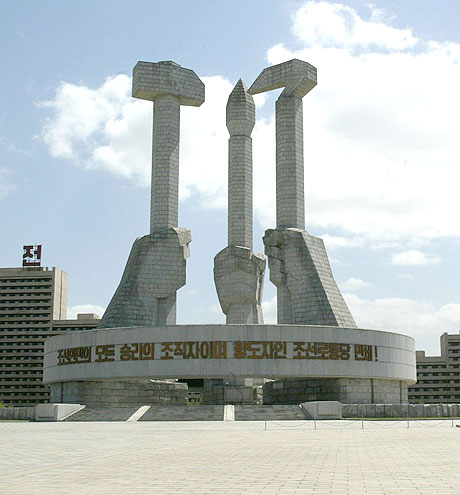
North Korean monument of the three revolutions in Pyongyang. Pyongyang was obliterated by American bombing raids and rebuilt. As a model city, the sick,elderly and those thought to be disloyal are moved out of the capital .
The Juche Tower in Pyongyang, taller than the Washington monument. North Korea uses the Juche calendar, beginning with the year 1912, the year of Kim Il Sung's birth The most authoritative map of North Korea on Google Earth
Kin Il Sung and Ho Chi-Minh,1958 in Hanoi During the Vietnam War, North Korea provided substantial economic and military aid to North Vietnam. In 1968, approximately 2,000 Vietnamese students and trainees received education for free in the DPRK. 1967 North Korea sent a fighter squadron to North Vietnam to back up the North Vietnamese 921st and 923rd fighter squadrons defending Hanoi. They stayed through 1968; 200 pilots were reported to have served. In addition, at least two anti-aircraft artillery regiments were sent as well. North Korea also sent weapons, ammunition and two million sets of uniforms to their comrades in North Vietnam. From 1968, however, relations between Pyongyang and Hanoi started to deteriorate for various reasons. Anxious to keep the United States bogged down in Vietnam, North Korea disagreed with North Vietnam's decision to enter peace negotiations with the U.S., and reacted negatively to the Paris Peace Accords. wikipedia
North Korean department store 백화점 By the 1960s North Korea was the second most industrialized nation in East Asia, trailing only Japan. While a number of internal limitations appeared, such as in the production of consumer goods, the national standard of living was considered by many third-world nations as an alternative to the capitalist model of development sponsored by the United States. Building upon the ruins left by the Korean War, the North Korean economy by the late 1960s provided its people with medical care, universal education, adequate caloric intake, and habitable housing. By the early 60s, many thousand ethnic Koreans in Japan began to migrate back to North Korea, where they believed they had greater opportunities . An estimated 90,000 ethnic Koreans living in Japan (zainichi, long term Korean residents of Japan who trace their roots to the period of Japanese colonialism in Korea) returned to North Korea mostly from 1956 to 1965 . As word of the harsh living conditions spread, repatriation declined sharply, though it continued as late as 1984.
This is a 1960 Soviet news reel about the return of Koreans who had been living in Japan to North Korea.
|
||||
|
Kim Il-Sung's life to the Korean War 1912 - 1950s |
||||