|
The Three Kingdom Period 57 BC - 668 AD
During the Three Kingdoms period, the Koguryo ( Goguryeo 고구려 高句麗 37 BCE–668 CE ), Paekje ( Baekje 백제 百濟 18 BCE–660 CE ) , and Silla (Shilla 신라 新羅 57 BC–935 CE ) kingdoms and the Kaya confederate states established hereditary monarchies and definite borders. Although their beginnings (late 1st century B.C.) are masked in a haze of uncertainty and myth (legend tells that the first rulers of Koguryo, Silla, and the Pon Kaya state were mysteriously born of eggs), these nations probably became recognizable entities by A.D. 200. After A.D. 200, direct Chinese influence on these emerging states diminished as China struggled with internal problems.
Korean history - Silla Kingdom The year 57BC marks the beginning of the Silla Dynasty. Together with the Goguryeo and Baekje, Silla was the third of the Three States Era, controlling the southeastern region of the Korean peninsula for 1000 years. Silla fostered dramatic development in the sciences, mathematics, culture and religion.
A hereditary system of kingship and privileged aristocracy evolved, a state bureaucracy developed to deal with the increasingly complex domestic and foreign situation, explicit laws were promulgated, and military units were strengthened. Animistic and shamanistic beliefs and cultural rituals gained more significance. Buddhism became the state religion and Confucianism its ethical foundation; the first educational institutions were established during this period. Growing interest in literature and the arts spawned the writing of national histories, the development of a writing system that used Chinese characters to phonetically express spoken Korean, and the creation of religious structures. The potter's wheel was introduced, more and diverse metal objects were made, precious stones and glass began to be worked, and burial was done in wooden coffins and earthenware jars. Migration to Japan continued, affecting the formation of its early states by introducing such things as Buddhism and religious books, Confucianism and classic texts, Chinese and Korean political organizational structures, artisans and craftsmen, artistic and architectural designs, Chinese and Korean music and dance, styles of dress, astrology, and calendars.
Shilla ceramic
In the early Common Era, the Three Kingdoms (Goguryeo, Shilla, and Baekje) conquered other successor states of Gojoseon and came to dominate the peninsula and much of Manchuria. During this period, Koreans played an important role as a transmitter of cultural advances, aiding the formation of early Japanese culture and politics. Census records from early Japan show that most Japanese aristocratic clans traced their lineage to the Korean peninsula. The Japanese Emperor stated that "it is recorded in the Chronicles of Japan that the mother of Emperor Kammu was of the line of King Muryeong of Baekje," and "I believe it was fortunate to see such culture and skills transmitted from Korea to Japan." The Korean kingdoms competed with each other both economically and militarily. While Goguryeo and Baekje were more powerful for much of the era, defeating Chinese invasions several times, Silla's power gradually extended across Korea and it eventually established the first unified state to cover most of Korean peninsula by 676.
Koguryo (Goguryeo ) 37 BC – 668 and the Rise of Paekche 百濟 ( Baekje ) 18 BC – 660
General's tomb in Ji'an China, next to North Korea. Ji'an ( called Gungnae seong , 國內城) was the Koguryo capital for from 3 AD to 427, until moved to modern day Pyongyang .Unlike the round grass tombs of Silla and Paekche, Koguryo used pyramid shaped tombs .
Korean history - Goguryeo, the powerful kingdom in ancient Northeast Asia Goguryeo was the powerful kingdom in ancient Northeast Asia. It was established in B.C. 37. Most Koreans still love this kingdom's story and the relics of them. Although, it was Korean independent kingdom, Chinese government is distorting the history of this kingdom and trying to adopt this history to their history Goguryeo was an ancient kingdom located in southern Manchuria (present-day Northeast China), southern Russian Maritime province, and the northern and central parts of the Korean peninsula. It was one of the Three Kingdoms of Korea, along with Baekje and Shilla, and it is also considered an important regional kingdom in Manchuria by the People's Republic of China. It was an active participant in the power struggle for control of the Korean peninsula as well as the foreign affairs of associated polities in China and Japan. The Samguk Sagi, a 12th century CE Goryeo text, indicate that Goguryeo was founded in 37 BCE by Jumong, a prince from Buyeo, although there is archaeological evidence that suggests Goguryeo culture was in existence since the 2nd century BCE around the fall of Gojoseon, an earlier kingdom that also occupied southern Manchuria and northern Korea. Koguryo tomb painting
Koguryo (Kao-chii-li) had a history of 300 years before it overthrew Lo-lang Province and laid the ground for its power expansion on the peninsula. According to the legend of Koguryo, the tribe originated from the Fu-yii tribe in northern Manchuria and had occupied an area at the foot of the Long White Mountains by the time it made its first appearance in history around 100 B.C. Its members probably moved south along the Sungari River from their original community. After the Hsian-t'u Province moved in about 75 B.C. from the present Hamgyong-do to the north of the Yalu River, the Koguryo tribes led their life independently outside its boundaries. In the early days of the Latter Han Dynasty, their chief was given the title of the King of Koguryo, and they were usually obedient to China, receiving Han ranks and official uniforms. Yet at times they made inroads to the province, the Koguryo tribesmen Were put under the control of the Province but attacking also Liao-tung Province, moving across the Liao River and staging battles with the Chinese forces. At the end of Latter Han period of China, the Kung-sun family who established the Tai-fang Province sent forces to fight Koguryo and finally defeated the tribe at its stronghold along the T'ung-chia River. Driven out of their city, the Koguryo moved south to build a new city called Wan-tu on the so-called T'ung-kou plain lying between the Yalu River and one of its tributaries, the T'ung-kou River, around 210 A.D. The City of Wan-tu, also known as the Castle of Kungnae, is believed to have been located near either the present T'ung-kou County across the river from Manp'o-jin in the P'yongan-pukto, or the Shan-cheng-tzu Fortress situated north of T'ung-kou. A score of ancient mounds are to be found in the area today, and a number of mounds containing a beautiful wall painting have been discovered. The historical drama Dae Joyoung, which takes place in the Koguryo kingdom
Koguryo, which suffered a blow at the hand of the Kung-sun family, recovered from the damage in their new stronghold and renewed their attack on Hsian-t'u Province. When Wei Kingdom in North China attacked Wu Kingdom in the south, Koguryo made an alliance with Wei forcing the Kung-suns to fight on two fronts; at the same time, Koguryo established ties with Wu sending emissaries via the sea to the court Sun Ch'iian, on a policy of befriending distant states and antagonizing neighbors. But after the Kung-suns were destroyed by Wei in 238 A.D., Koguryo faced invasion from Wei and Wu. In 244A.D., General WuCh'iu Chien of Wei captured Wan-tu and, in the following year, sent the governor of Hsian-t'u Province to drive the king of Koguryo far out into the land of Wo-chi or the present Hamgyong-do and had the governors of the Lo-lang and Tai-fang Provinces clear the eastern coast of the peninsula which had been under the control of Koguryo.
video on the important people in Koguryo history Koguryo appeared completely subdued for some time as a result of these extensive maneuvers; but the tribe again came to life and staged an offensive in the Liao-tung area during the Western Chin Period (265-316 A.D.). At this time, the provinces of Lo-Iang and Tai-fang were under the control of Chang T'ung who came from Liao-tung. Chang T'ung opposed the newly risen Koguryo for some time but finally retreated to Liao-hsi in 313 A.D. with his subjects, to leave Lo-Iang and Tai-fang entirely in the hands of Koguryo. Usually, this year is regarded as the last of the Lo-Iang Province-just 420 years after Wu-ti of Han set up the four provinces on the peninsula. Koguryo's ultimate victory is attributed to a number of factors and causes, but the most important reasons was apparently the close unity of the tribal members and its tightlyknit organization. The tribe had five classes of peers: Chiiannu-pu, Chiieh-nu-pu, Shun-nu-pu, Kuan-nu-pu and Kuei-loupu. The organization changed and grew as the tribe developed and times changed. The movement of its center to Wan-tu, which was mentioned earlier, is believed to have been one of the instances which provided an important momentum toward reshaping the organization of the tribe to meet a new situation. The building of the City of Wan-tu was an unavoidable outcome of Koguryo's defeat by the Kung-suns, but it gave the tribe an unexpected opportunity to recognize itself and opened the way for a new class to come to power and lay the foundation for future development and prosperity. It was about 100 years after they moved to Wan-tu that the Koguryo completed overthrowing the Chinese rule of Lo-Lang. For several decades after the capture of Lo-Lang Province, Koguryo was unable to strengthen its hold on the Korean Peninsula as it was absorbed in waging war in the Liao-tung district. North China had entered into the turbulent days of the so-called Sixteen Kingdoms and Koguryo was absorbed with continual conflicts. For a period of three years beginning in 339 A.D., the invasion of the Mu-jung family from the north dealt a damaging blow comparable to that dealt to General Wu-ch'iu Chien of Wei about a century before. The city fell to the invaders, and the tomb of the father of the King was opened and sacked. At the same time, it must be noted that there were many exiles from China into Koguryo in this tumultuous age and these exiled Chinese made great contribution to the development of Koguryo's politics and culture
The right to the throne in Koguryo was permanently secured by the Ko house in the time of King Taejo (53-146), and from Kogukch'on (179-196) the processes of strengthening the kingly of centralizing the nation's political structure went ahead rapidly. In the first place, the five tribal enclaves that represented enclaves from the earlier traditional society were restructured into five "provinces" (pu), with names that connoted the directions of north, south, east, west, and center. This signifies the strengthening of the centralized governmental structure. Secondly, succession to the throne on the whole no longer went from brother to brother but changed to a father to son , and this represents a further enhancement of the power of the kingship. Thirdly, it became established practice for queens to be taken from the Myongnim house of the Yonna (Chollo) lineage. The creation or this special tie between the royal house and a single aristocratic lineage may be seen as an attempt to place restraint on other potential power centers opposed to the growth of monarchical authority. Such changes as these constitute the setting in which Koguryo pressed ahead with its advance toward the basins of the Liao River to the west and the Taedong River to the south. And eventually, under King Mich'on in 313, Koguryo succeeded in seizing the territory of the Lo-lang Commandery and occupying the Taedong river region. At the same time, however, Koguryo came into sharp confrontation with Paekche, which had pushed northward to gain hold over the former domain of the Tai-fang Commandery in modern Hwanghae province.
Koguryo-Japan conflict
Gwanggaeto or Kwanggaet'o Stele in Jian, China. erected in 414 A.D.
The Stele of Gwanggaeto the Great of Goguryeo The stele of Gwanggaeto the Great of Goguryeo was erected in 414 by Jangsu of Goguryeo as a memorial to his deceased father. It is one of the major primary sources extant for the history of Goguryeo
The era of Koguryo-Japan conflicts is monumentalized by the Monument of King Kwanggaet'o, which iooms up outside the T'ung-kou County along the Yalu River, where an ancient capital of Koguryo was located. The Monument was built in 414 A.D., two years after the death of the King. The existence of the monument has been known to the Korean people for five centuries. But it was only about 80 years ago that the epitaph on the monument was deciphered and studied by Japanese and Chinese scholars. The decoding of the epitaph gave important clues to the study of the Korean Peninsula's ancient history. The epitaph, describing the life history of King Kwanggaet'o, dealt largely with the king's "down to the South" expansion policy, and therefore touched on the struggle between Koguryo ana Japan. The king acceded to the throne at the age of eighteen in 391 A.D. and reigned the country for 22 years. During his regime, the king successfully prevented the invasion of Yen forces from Liao-tung in the north and at the same time sent his army to the south to fight back the Japanese troops. The epitaph of the monument shows that the king sent his troops four times to the south-in 396 A.D. for an expedition to Paekche, in 399 A.D. to demonstrate his military strength in the south, in 400 A.D. to help Silla and in 404 A.D. to have a naval battle with Japan.
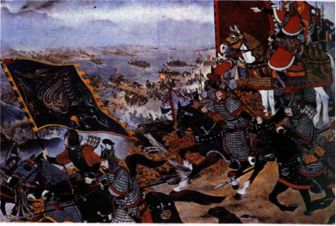
King Kwanggaet'o in battle The epitaph says that the king's first expedition to Paekche was indirectly aimed at driving the Japanese power behind Paekche out of the peninsula. The king brought his powerful naval forces to Paekche and took some 50 Paekche castles. When his forces approached the Paekche Metropolis after crossing the Han River, Paekche King surrendered. The second expedition to the south was to punish Paekche, which had maintained friendly relations with Japan in breach of its agreement with the king. During this expedition, Shilla sent an envoy to the king's camp asking the king's help to get rid of the Japanese forces that had occupied Shilla atthat time. Thus, the third expedition to the south. This time, the king led 50,000 soldiers to enter Shilla and reached Kara, pursuing Japanese troops. The naval battle in 404 A.D. took place in the Tai-fang border on the west coast of the Central Peninsula which is believed to be off Inch'on Bay .That all these four expeditions had something to do with the Japanese forces shows how far Japanese power had reached in the peninsula at that time. Two most significant results of these expeditions were that the relationship between Koguryo and Shilla was improved radically and that Paekche lost its power in the Han River area, which caused the country to move its capital to the south. King Changsu, who succeeded King Kwanggaet'o, was on the throne for 79 years as his name (king longevity) indicates. He followed King Kwanggaet'o's policy and promoted the "Expansion to the South" project positively. The removal of the capital from Wan-tu to P'yongyang in 427 A.D. was highly significant in the process of the expansion-to-thesouth-policy. Goguryeo–Sui Wars (598 – 614)
Battle of the Salsu river in 612 In 612, the Sui Emperor Yangdi invaded Goguryeo with 1,133,800 men. However, Goguryeo continually resisted their enemy. Emperor Yangdi dispatched 305,000 men to Pyongyang, capital of Goguryeo. However, at this time, Goguryeo General Eulji Mundeok defended fortresses against the Sui army and navy for several months and destroyed the Sui troops while retreating into Goguryeo territory. An ambush at Salsu (Chongchon River) caused massive Sui casualties. From the historical drama Yeon Gae So The Goguryeo-Sui Wars were a series of campaigns launched by the Sui Dynasty of China against the Goguryeo kingdom between 598 and 614. It resulted in the defeat of Sui and contributed to its eventual downfall of the dynasty in 618. The Sui Dynasty united China in 589, defeating the Chen Dynastyand ending the division of the continent that spanned almost 300 years.After the unification of China, Sui asserted its position as theoverlord of all of Asia, and most countries submitted themselves. However, in Goguryeo, one of the Three Kingdoms of Korea, Pyeongwon and his successor Yeongyang insisted on maintaining an equal relationship with the Sui Dynasty.Wendi of Sui was displeased with the challenge from Goguryeo, which continued small scale raiding into Sui's northern border. Finally in 612, Yang Ti, the Sui Dynasty emperor, decided to subdue his dangerous neighbor and prepared to attack Koguryo. According to Chinese accounts, Emperor Yang Ti prepared a force of over one million men and personally led them against Koguryo. They quickly overran Koguryo outposts, camped on the Liao River and prepared to bridge the river. Ulchi Mundok was called upon to assist in the defense of the nation. He prepared to meet the superior Sui forces with a strategy of retreat, deception and attack. After the Sui forces crossed the Liao river a small contingent was sent to attack the city of Liaotung. General Ulchi Mundok sent his forces to meet them there and drove them out in a rout. The Sui forces tried other probes of little significance biding their time until the rainy season passed. Following the rainy sea?son the Sui moved their forces to the banks of the Yalu River in northwestern Korea and prepared for a major assault. General Ulchi Mundok visited the Chinese camp under the guise of surrender in an attempt to discover any weakness of the force. The king listened to General Ulchi Mundok and allowed him to leave the camp. Shortly after, Emperor Yang Ti changed his mind and set out after the general but it was too late. The general had discovered what he needed to defeat the force. He learned that the Sui forces were short of provisions and had overstretched their supply lines. General Ulchi Mundok decided to pursue a strategy of gradual retreat, luring his enemy deeper into hostile territory. He fought a kind of guerrilla warfare, picking when and where he fought and allowing the Sui forces to feel as though victory was close at hand, while luring them deeper into his trap. An advance force of over 300,000 was sent to take the city of Pyongyang. General Ulchi Mundok continued to lure them closer to the city to a strategic point where he could strike. His forces attacked from all sides driving the Sui troops back in utter confusion. Koguryo forces continued the pursuit slaughtering them almost at will. It is said that only 2,700 troops successfully made it back to the main body of forces. Winter soon began to set in and the Sui forces, short on provisions, were forced to return home. Beginning the following spring a second and third attack met similar disaster. Internal rebellion in China forced the Sui to give up its desires on Koguryo. By 618, the relatively short lived Sui Dynasty was replaced by the Tang Dynasty. General Ulchi Mundok's strategy and leadership had saved Koguryo Korea from the Chinese. Unfortunately for Koguryo, the emerging Shilla Kingdom would unite the peninsula some fifty years later. General Ulchi Mundok is still celebrated as a great Korean hero. A main street in downtown Seoul, Ulchi-ro, is named for him. His victories are remembered as a time when the smaller Korean kingdom was able to decisively defeat the vastly larger Chinese nation.
Ulchi Mundok/Eulji Mundeok
One of the the most distinguished military leader of the Koguryo period and one of the most well-known generals in Korean history, General Ulchi Mundok's leadership and tactical owledge was the decisive factor in saving KoguryoKoryo from destruction at the hands of Chinese forces of the Sui. He faced invading forces of far superior numbers and not only turned them back but was able to pursue and destroy them with such vigor that they were not able to return. Much of his early life's story is sketchy but his later life was filled with enough spectacular success to earn him a permanent place among Korea's most remembered.
The Rise of Paekche
Mireuksa Temple, Paekche. Constructed around 600
Korean history - Baekje Kingdom In 18 B.C., Baekje was founded in the Hangang River basin, emerged as the dominant kingdom of the Three Kingdom Period (5th century). It became the center of northeast Asia's economy and trade due to its important role as marine traffic route. Furthermore, Baekje dispatched many scholars including Ah Jikgi and Wang In These scholars introduced Buddhism, the thousand-character text and Chinese literature to Japan. Their teachings helped Asuka culture - Japans first Buddhist culture in the 7th century - to flourish. It has been noted earlier that Paekche originally developed out of one of the walled-town states (also known as Paekche) that comprised the Mahan area, over which the "Chin-king" had ruled. It is not certain just when this original Paekche emerged as a confederated kingdom incorporating the various walled-town states in the Han river basin. But by the year 246,when the Lo-lang and Tai-fang commanderies (then under the dominion of Wei of the Chinese Kingdoms launched a large-scale attack against the Han River region already was gaining in strength in this area, for the purpose of the Wei army's attack was to disrupt and consolidation of this new power. In the ensuing warfare the of Tai-fang, Kung Tsun, was killed in battle. This surprisingly new entity surely was not Mahan but rather the newly confederated kingdom of Paekche led, no doubt, by King Koi (traditional reign dates (286), who is known to have been active in other arenas around this time.
King Koi is thought to have been the same historical figure as Kui, the Paekche later was to honor as its founder-king with commemorative ceromonies performed four times yearly. In the twenty-seventh year of hisreign, 260, we are told that six ministers (chwap'yong) were appointed 10 conduct the affairs of state along appropriate functional lines, sixteen titles of official rank were created, and colors for official dress were prescribed in accordance with rank. It is further recorded that in 262 that the King decreed that officials who accepted bribes or those guilty of extortionate policies would be required to pay three-fold compensation and in addition would be barred from office for life. And the king displayed his majesty by receiving his subjects bedecked in stunning finery. All this conjures lip a vivid image of a powerful political leader.
Nakhwa-am ' Falling Flowers Rock' by the last Paekche capital,(Sabi) where 3,000 court ladies jumped off to commit suicide rather than be captured during the sack of 660 AD.
The structuring of Paekche into a centralized, aristocratic state appears to have been completed in the reign of King Kiln Ch'ogo (346-375), A formidable warrior king, in 369 he destroyed Mahan, which by this time Paekche to have moved its capital southward to the modern Iksan area, and look possession of the whole of its territory. Then, in 371, Paekche struck northward into the Koguryo domain as far as P'yongyang, killing the Koguryo king, Kogugwon, in the course of the campaign. Paekche thus came to hold sway over a sizeable portion of the Korean Peninsula, including all the modern provinces of Kyonggi, Ch'ungch'ong, and Cholla, as well as parts of Hwanghae and Kangwon. Furthermore, King Ch'ogo modified his international position by making overtures to the Eastern Chin state in the Yangtze river region and to the Wa people in Japan.
It is not surprising that from the time of this warrior king the power of the throne in Paekche came to be increasingly authoritarian. Father to son succession to the kingship is thought to have begun from King Kiln Ch'ogo was also from his reign that the so-called "age of Chin family queens" began, as Kiln Ch'ogo's immediate successors continued to choose their consorts from this single aristocratic house. King Ch'ogo's command to the scholar Kohilng to compile the Sogi, a history of Paekche, clearly reflects the king's desire to exult in his expanded royal authority and his well ordered state, Kiln Ch'ogo was succeeded by Kiln Kusu (375-384), whose death was immediately followed by King Ch'imnyu's adoption of Buddhism (in 384) and the implanting of the new value system of that faith.
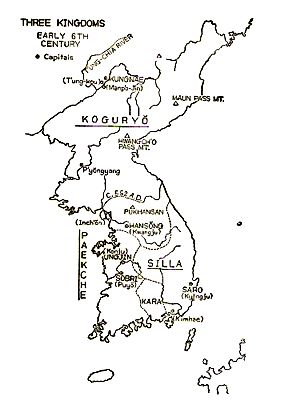
As a result of King Changsu's expedition to the south in 475 A.D., Paekche at last lost its capital Hansong, and moved the capital to Ungjin (now Kongju). Paekche had to move its capital again 60 years later from Ungjin to Soburi (now Puyo), which became the country's last capital. In this regard, the history of Paekche can be divided into three as follows:Hansong Era (Kwangju) (*350-475) Ungjin Era (Kongju) (475-538) Soburi Era (Puyo) (538-660)
Paekche's retreat to the south naturally influenced Japanese power in the peninsula. Every time Paekche moved to the south, Japan ceded part of Kara to encourage Paekche to recover its power. Consequently, Japan lost most of the western half of Kara. :It must be noted, however, that Paekche's retreat the south was not caused merely .by Koguryo's invasion. Koguryo's invasion did constitute one of the major pressures outside to force Paekche to move its capital to the . But it is also true that Paekche itself had planned to move its capital to improve the country's administration and cultural l system in an effort to recover its national prestige, this was particularly true of the capital's removal to Soburi. The most remarkable of Paekche's politico-military organization were the five pu's of the capital and the five pang's of local territories. The former-consisting of the Upper, Middle Lower ,Front and Rear pu's-together designated five quarters of the capital, at the same time probably meaning five sections of the ruling class; the latter-Middle, Eastern, Southern, Western and Northern pang's-were primarily military districts with some administrative functions.. Unlike Paekche, Shilla maintained its metropolis in Kyongju from the beginning and achieved a gradual development the country. Since the country was located very close to Kara, the conflicts with Kara always posed major diplomatic problems. While Paekche expanded its territory into Kara, which was under Japan's control, in the form of agreed cession from Japan, Shilla gradually invaded and amalgamated Kara. territory. Its invasion to Kara reached its peak during the, age of King Pophiing, and was completed in the age of his successor, King Chinhiing in 562 A.D. King Chinhiing's "Monument of Territory Exploration," built in 561 A.D. in Changnyong, Kyongsang-namdo, commemorates Shilla's expansion into Kara. Thus, the fall of Kara in 562 A.D. as the result of the invasion by Paekche in the west and by Shilla in the east, meant the virtual end of Japan's control on the southern part of the peninsula, and the beginning of the new era of a tripartite struggle between Koguryo, Paekche and Shilla. It was about 170 years after Japan had battled with the army of the King Kwanggaet'o that Kara perished. During that 170 odd years, Paekche approached Japan to maintain its power in the peninsula, while Shilla strengthened its ties with Koguryo to achieve its national development, though there were some minor changes in their diplomatic policies at times. At the same time, Paekche exchanged friendly relations with China's Southern Dynasties, while Shilla and Koguryo sought the support of the Northern Dynasties. In this respect, it can be said that the tripartite division of the peninsula at that time had some connection also with the struggle between the Southern and Northern Dynasties of China. Paekche incense burner, from Nonsanri Tombs Paekche or Baekje and Shilla Let us now examine the situation in the south while Koguryo was kept busy dealing with the threat from the north. As mentioned earlier, this was a blank period of history and not much can be said definitely about the south. However, it is assumed that Ma-han and Ch'en-han which had established contacts with China toward the end of the period of Lo-Iang, were finally released from Chinese control through the destruction of Lo-Iang and Tai-fang and finally developed into the two new states of Paekche and Silla. These two states appear in Chinese history almost simultaneously around 372 A.D. Although the legends of these two states relate that their beginning was in the late first century B.C., circumstances show that they were formed in the midfourth century A.D. when Paekche was under the reign of King Kunch'ogo and Silla was ruled by King Naemul. Among the factors which worked on the emergence and development of these two kingdoms, one of the most significant was their relations to Japan. Activities of the Japanese people had ceased to be recorded by Chinese historians since 266 A.D. It was not until 413 A.D. that the Japanese resumed sending envoys to the Chinese Court, and after that date the situation in Japan became more or less known to outsiders. It is improbable that the Japanese had completely withdrawn from the Korean Peninsula during these one and half a centuries, in view of the fact that, at the time when Paekche and Shilla were growing out of Ma-han and Ch'en-han respectively, Pien-ch'en remained disunited as Kara States or in Japanese Mimana, being under the direct control of Japan while Paekche and Silla were relatively independent, only tied by a pledge of allegiance to Japan. This seems to indicate that, although in the third century the Japanese influence in the Korean Peninsula had dwindled temporarily in the face of the rising Han kingdoms, the Japanese tried successfully to reestablish themselves in the Pien-ch'en area by sending a large army across the sea soon after the downfall of the two Chinese provinces in the peninsula, thus creating the Mimo-no, territory to counter the strong movement of the Han kingdoms toward a unity and to prevent the realization of a unified South Korea, and resulting in a competition between Shilla in the east and Paekche in west. It is true that the tripartite division of the peninsula by Shilla, Paekche and the Kara group was to some extent an achievement by the Han kingdoms who had been striving toward a unified Korea. Yet the situation cannot be regarded as a completely smooth and unhindered development, for a similar division of the peninsula had already existed in the third century, and this seems to be too slow a progress to be achieved in the course of more than one and a half centuries. Such Japanese expansion into Korea in protohistoric times has probably formed a factual core of the legend of the famed expedition to Korea by the Empress Jingii related in old Japanese chronicles in a vague, mythical way. Moreover, there is no doubt about a deep Japanese influence on the growth of Shilla and Paekche. A good corroboration to this view is found in the fact that, when Koguryo turned from the Liao-tung area to start a southward advance in the Korean Peninsula, she ran into stiff opposition from the Japanese sphere of influence which covered both Shilla and Paekche, and that a period of Koguryo-Japanese rivalry over the hegemony in the peninsula had to ensue for quite some time. Usually the Three Kingdoms Period is regarded as having begun in the mid-fourth century when Shilla and Paekche emerged, but in actuality it began only after the competition between Koguryo and Japan had subsided. Baekje's foundation by King Onjo in 18 BCE , as stated in the Samguk Sagi followed those of its neighbors and rivals, Goguryeo and Silla. The Sanguo Zhi mentions Baekje as a member of the Mahan confederacy in the Han River basin (near present-day Seoul). It expanded into the southwest (Chungcheong and Jeolla provinces) of the peninsula and became a significant political and military power. In the process, Baekje came into fierce confrontation with Goguryeo and the Chinese commanderies in the vicinity of its territorial ambitions. At its peak in the 4th century, it had absorbed all of the Mahan states and subjugated most of the western Korean peninsula (including the moder provinces of Kyonggi, Chungcheong, and Jeolla, as well as part of Hwanghae and Kangwon) to a centralized government. Baekje acquired Chinese culture and technology through contacts with the Southern Dynasties during the expansion of its territory. Baekje played a fundamental role in transmitting cultural developments, such as Chinese characters, Buddhism, iron-making, advanced pottery, and ceremonial burial into ancient Japan. Other aspects of culture were also transmitted when the Baekje court retreated to Japan after Baekje was conquered. Baekje was defeated by a coalition of Shilla and Tang Dynasty forces in 660. According to legend, the kingdom Shilla began with the unification of six chiefdoms of the Jinhan confederacy by Bak Hyeokgeose in 57 BCE, in the southeastern area of Korea. Its territory included the present-day port city of Busan, and Shilla later emerged as a sea power responsible for destroying Japanese pirates, especially during the Unified Shilla period. Silla artifacts, including unique gold metalwork, show influence from the northern nomadic steppes, with less Chinese influence than are shown by Goguryeo and Baekje. Silla expanded rapidly by occupying the Han River basin and uniting the city states. By the 2nd century, Silla existed as a large state, occupying and influencing nearby city states. Silla began to gain power when it annexed in 562 the Gaya confederacy, between Baekje and Silla. Silla often faced pressure from Baekje and Japan, and at various times allied and warred with Baekje and Goguryeo. In 660, King Muyeol of Silla ordered his armies to attack Baekje. General Kim Yu-shin, aided by Tang forces, conquered Baekje. In 661, Silla and Tang moved on Goguryeo but were repelled. King Munmu, son of Muyeol and nephew of General Kim, ordered his uncle to launch another campaign in 667 and Goguryeo fell in the following year. Koguryo in Full Flourish
The invasions of the Earlier Yen (founded by the Mu-jung tribe of the Hsien-pei) and of Paekche, both in the time of King Kogugwon, dealt a severe blow to Koguryo. To surmount its difficulties it was necessary for Koguryo to reshape the pattern of its institutions. This task was undertaken by King Sosurim (371-384), who adopted Buddhism and established a National Confucian Academy (the T'aehak) in 372 and in the next year promulgated a code of administrative law. If Buddhism would serve to give the nation spiritual unity, then the National Confucian Academy was essential to the creation of a new bureaucratic structure, and an administrative code would systematize the state structure itself. Unfortunately we do not know the contents of the statutory code enacted at this time, but there is no question that it signifies Koguryo's initial completion of a centralized aristocratic state structure.
These internal arrangements laid the groundwork for the external expansion that presently would ensue. It was King Kwanggaet'o (391-413) who pursued most vigorously the task of adding new domains to Koguryo by conquest. The great military campaigns of this king, whose name literally means "broad expander of domain," are recorded in detail on the huge stone stele still standing at his tomb in Kungnae-song (at modern T'ungkou, on the Manchurian side of the mid-Yalu river), then the capital of Koguryo. According to this inscription, in the course of his reign of just twenty-odd years, King Kwanggaet'o conquered a total of sixty-four fortress domains and 1,400 villages. Leading his cavalry forth across all of Koguryo's land boundaries, he won a succession of notable victories: in the west he occupied Liao-tung, long the focal point of a fierce struggle between Koguryo and both Chinese and non-Chinese states; he subdued the Sushen people, a Tungusic tribe to Koguryo's northeast, thus making himself the master of Manchuria; to the south he attacked Paekche, extending Koguryo's frontier into the region between the Imjin and Han rivers; and far to the southeast, in the Naktong river basin, he crushed a Wu Japanese force attacking Silla. Kwanggaet'o instituted his own era name, Yongnak ("Eternal Rejoicing"), thus arrogating to Koguryo a status of equality with China. After his death he was honored with a long title that, with abundant good reason, proclaimed his awesome kingly achievements.
Kwanggaet'o was succeeded by King Changsu ("the long-lived" 411 - 491), who during his seventy-nine years on the throne continued his father's enterprises and brought Koguryo to its flourishing height. He held China in check by employing a diplomatic strategy of maintaining ties with both the Northern and Southern Dynasties, thus enabling him to manipulate these two contending forces to Koguryo's advantngr And in 427 he transferred the Koguryo capital to P'yongyang, creating 11 new epicenter for the nation. This move from a region of narrow valleys to a broad river plain indicates that the capital could no longer remain primarily a military encampment but had to be developed into a metropolitan center for the nation's political, economic, and social life. And indeed this period saw the perfecting of Koguryo's political, economic, and other institutional arrangements.
The shift of Koguryo's capital far southward to P'yongyang of course posed a serious threat to Paekche and Silla. The alliance that these two now forged (in 433), as well as Paekche's embassy to the Chinese Northern Wei kingdom in 472 to appeal for military support against Koguryo's southward aggression, were developments dictated by the acute peril Paekche, in particular, faced. But in vain, for in 475 Koguryo seized the Paekche capital at Hansong (modern Kwangju just south of Seoul), captured King Kaero, and beheaded him. Paekche moved its capital south to Ungjin (modern Kongju), barely managing to preserve its national existence. The Koguryo dominion thus had come to extend southward to a line drawn from the area of Chungnyong Pass (linking modern North Kyongsang and North Ch'ungch'ong provinces) to the Bay of Namyang . Koguryo had fashioned a great empire with well functioning institutional machinery, embracing a vast territory stretching far into Manchuria and the Korean Peninsula, and so now came to contend for supremacy on the field of battle with China.
The Rise of Shilla and Kaya
As already narrated, Shilla evolved out of Saro, one of the twelve walledtown states in the Chinhan area of southeastern Korea. This state of Saro took the lead in forming a confederated structure with the other walledtown states in the region, and it is thought that the appearance of the first ruler from the Sok clan, King T'arhae (traditional dates 57-80 A.D.), marks the beginning of this gradual process. By the time of King Naemul (356402), then, a rather large confederated kingdom had taken shape, controlling the region east of the Naktong River in modern North Kyongsang province. Through both conquest and federation, Saro now had reached the stage where it rapidly would transform itself into the kingdom of Shilla. Naemul, the central figure in this unfolding historical drama, adopted a title befitting his new position as the ruler of a kingdom. Instead of isagum ("successor prince"), the term used by his predecessors, Naemul took the title maripkan, a term based on a word meaning "ridge" or "elevation." From this point on, the kingship no longer alternated among three royal houses but was monopolized on a hereditary basis by Naemul's Kim clan. In the course of his reign Naemul sought help from Koguryo in thwarting the designs of Paekche, which was making use of both Kaya and Japanese Wa forces to harass the fledgling Silla kingdom. This effort was successful, but it led to a slowing of the pace of Silla's development.
The lower reaches of the Naktong River, where Kaya emerged, originally were the territory of the twelve "states" of Pyonhan. These had not come under the dominion of the "Chin-king" but through confederation had formed an independent entity. Among the original twelve states, Kuya at modern Kimhae honored Suro as its first king and developed into the Pon ("original") Kaya kingdom, while in the region of Koryong the Mio yama state accepted Ijinasi as its first ruler and evolved into Tae ("great")Kaya . Pon Kaya and Tae Kaya then joined with the other walled-town states in the lower Naktong region to form the Kaya federation.
With its Naktong River location, Kaya (and in particular Pon Kaya at the mouth of the river) engaged in vigorous maritime activities, maintaining contacts far up the western coast of the peninsula with the Chinese commanderies of Lo-lang and Tai-fang, northward along the east coast with the Ye people, and southward with the Wa in Japan. But Kaya was caught between Shilla and Paekche, and the struggle between those two kingdoms rendered it impossible for Kaya to achieve full political and societal development. Moreover, when Paekche brought in Wa troops to attack Silla by way of Kaya, Silla and Kaya came into sharp conflict and this eventually led to the dispatch of a force by Koguryo's King Kwang gt'o in support of Silla (400 A.D.). Thereafter Kaya came under persistent harassment from Silla, until first Pon Kaya, in 532, and then Tae Kaya, 111 562, succumbed to Silla's growing might. The other petty states in the lower Naktong region suffered the same fate, thus bringing about the downfall of the Kaya federation.
The Flourishing of Shilla and the Resurgence of Paekche
Silla had taken the step of fixing the right to the kingship in the house of Kim in the time of King Naemul, and before long, with the reign of Nulchi (417-458), the pattern of father to son succession to the throne was estabtalished . Shortly thereafter the six clan communities were reorganized into administrative "districts" (pu), bringing a step closer to fruition the design for centralization of governmental authority. It is not clear just when this restructuring was carried out, but it appears to have been under King Soji (479-500), that is, sometime in the latter halfof the fifth century. The establishment of post stations throughout the country and the opening of markets in the capital where the products or different locales might be traded were among the consequences, no doubt , of such a centralizing thrust in Shilla's governance of its domain. Meanwhile, to counter the pressure being exerted on its frontiers by Koguryo,Shilla had concluded an alliance with Paekche, in 433. It was at this time ,most likely, that Silla was able to fully free itself from Koguryo's influence in its internal affairs, and in the process Shilla's ties with Peakche became further strengthened. The fact that Silla forged marriage ties with King Tongsong of Paekche after the transfer of the Paekche capital to Ungjin in 475 is recounted in a well known tale, and in the ensuing years the two countries carried out joint military operations on several occasions.
Having experienced these domestic and external developments, Shilla finally completed the structuring of a centralized aristocratic state in the reign of King Beopheung (514-540). Under his predecessor, King Jinheung (500-514), Silla had achieved important advances in its agricultural technology, as plowing by oxen was introduced and, from about this same time, irrigation works were carried out extensively. The resulting increase in agricultural production must have been one factor in promoting change in Shilla society. In the political sphere, then, the nation's name was declared to be "Shilla" and the Chinese term wang ("king") was adopted in place of the native title . These Sinifications were not merely terminological changes but reflected Silla's readiness to accept China's advanced political institutions. Another significant political development of this period was the emergence of the Pak clan as the source of queens for Shilla's kings.
The foundation thus having been readied, an administrative structure fully characteristic of a centralized aristocratic state was created in Shilla in the reign of King Beopheung. The clearest indication of this development is the promulgation of a code of administrative law in 520. Although its provisions are not known with certainty, it is believed to have included such regulations as those delineating the seventeen-grade office rank structure, prescribing proper attire for the officialdom, and instituting the kolp 'um ("bone-rank") system. The adoption of an independent era name, (Initiated Beginning"), in 536 also is deserving of note, for it is evidence of the firm establishment of royal authority within Shilla and of Shilla's confident view of itself as a nation of equal standing in its international community even with China. The official adoption of Buddhism as the state religion, sometime between 527 and 535, is another memorable event . This provided an ideological underpinning for regional unity and solidarity in the newly centralized Shilla state.
At this point it became possible for Shilla too to go on the offensive in its relations with its neighbors. To be sure, this expansionist process had been lit work over a considerable period of time. King Chijung had subjugated the Eastern Sea island of Ullung in 512, and then in 532 King Beopheung had conquered Pon Kaya (the modern Kimhae region), thus providing a springboard for advance northwestward in the Naktong river But it was King Jinheung (540-576) who pushed ahead most vigorously with Shilla's territorial expansion. In 551 Shilla attacked the Koguryo territory in the Han river basin region, in concert with King Song, the architect of Paekche's recent resurgence. The ten counties in the upper reaches of the Han thus fell to Shilla, and before long Shilla drove Paekche out of the lower Han region, thus securing for itself the whole of the river basin, The enraged King Song then launched a frontal assault on Shilla in 554 but was himself killed in battle at Kwansan Fortress (modern Okch'on). The Silla-Paekche alliance, which had endured for 120 years, at last was sundered. Shilla's occupation of the Han river basin not only brought with it additional human and material resources but was important as well for providing a gateway through which Shilla might communicate with China across the Yellow Sea. In 562, moreover, King Jinheung destroyed Tae Kaya (the modern Koryong area), thus completing Silla's acquisition of the fertile Naktong river basin. In the northeast, too, Jinheung advanced Silla's frontiers into the Hamhung plain. The four monument stones erected at Ch'angnyong, Pukhan-san, Hwangch'o Pass, and Maun Pass to mark the monarch's personal tour of inspection of his new frontiers offer eloquent testimony to Chinhiing's achievements as a conqueror king.
Paekche, it will be recalled, had been forced to move its capital southward to Ungjin (modern Kongju) in 475 and for a time faced a threat to its very existence. Through the efforts of King Tongsong (479-501) and King Muryong (501-523), however, Paekche's fortunes somewhat revived. It was around this time that twenty-two districts (tamno) were created in the regions outside the capital and a prince or other member of the royal family established in each in an effort to strengthen national unity. But if a foundation for renewed national development were to be laid, it was essential for Paekche to escape the confines of the mountain-ringed Ungjin and administer its domain from a new capital more favorably located. With this objective in mind King Song (523-554) moved his capital to Sabi, on the broad plain at modern Puyo, and at the same time he renamed his kingdom "Southern Puyo." It is believed likely that the system of twenty-two separate central government offices and a territorial administrative structure consisting of five capital districts (pu) and five provinces (pang) came into being in conjunction with the removal of the capital to Puyo. Furthermore, King Song entrusted Kyomik and other monks with the task of fostering the spread of Buddhism, thus to make firm the nation's spiritual foundation. At the same time he further strengthened Paekche's ties with the Southern Dynasties of China. Having restructured his kingdom and built up its strength, King Song now turned his efforts toward recovery of Paekche's former territory in the Han river basin. To this end he made a pact with King Chinhiing of Silla and, taking advantage of internal dissension in Koguryo, struck northward. With the occupation of the lower reaches of the Han, he had for the moment attained his objective, but when Silla unexpectedly seized this fruit of his long and arduous endeavors, King Song saw his dreams end in failure. Enraged, the Paekche king tried to strike back at Shilla but was himself killed in battle, as we have seen. Thereafter Paekche looked upon Silla as its mortal enemy and, making common cause with its former foe, Koguryo, launched one attack after another against Shilla.
|
||||
|
100 BC-300 AD |
668 - 935 AD |
|||