|
The Tonghak (Donghak) Rebellion 1894 동학농민운동
Tonghak founder Ch'oe Che-u
Donghak Peasant Revolution In the 1860s, an indigenous religion, Tonghak (동학, 東學,Eastern Learning), which combined such aspects as the meditation of Buddhism, ethics of Confucianism, primal nature of Shamanism, Taoism cultivation of energy and the personal God of Catholicism to oppose 'Western Learning' (Catholicism) arose from the indignation of the lower classes of yangban (ruling aristocratic class) oppression and foreign influence in Korea, especially Christian missionaries and Japanese imports . It was not only a religious movement but a social movement as well and concerned with the peasantry and the improvement of their conditions and reform of the corrupt government. The idea of the dignity and equality of all men was to influence future democratic movements.The initial success of the revolt led a panic court to seek help from China and Japan, leading to the first Sino-Japanese War and Japanese colonization of Korea .
Increased taxes that forced many to sell their land, forced labor and other abuses caused many farmers to throw their lot in with the Tonghaks
The Passion of a Man Called Choe Che-u 동학, 수운 최제우 The historical drama details the persecution, arrest and execution of 19th century religious leader Choe Che-u.
Tonghak Beliefs
Tonghak beliefs began to be propagated by its founder, Ch'oe Che-u, (1824-1864) during the reign of Cholchong . Ch'oe wandered throughout the country for 21 years preaching his beliefs .His ideas were expressed in the Bible of Tonghak Doctrine (Tonggyong taejon) and Hymns from the Dragon Pool (Yongdam yusa).These preached that God and man are the same once he understands chigi, the equality of all people. One could obtain divine virtue through self discipline and understand the chigi, or pure force of the universe.Man could not be saved by only passively accepting God, but through his own actions .In also included popular shamanistic beliefs such as worshiping mountain gods and chanting magic formulas .Choe set his Donghak themes to music so that illiterate farmers could understand, accept, and remember them more readily. The growing popularity of the movement led to Ch'oe's arrest in 1863 and execution in 1864 .His executing sent many of his followers into hiding, but revived .
Catholic missionaries in Korea alarmed many Koreans
Later, the Tonghak name was changed to Ch'ondogyo ( Religion of the Heavenly Way ) or Cheondoism It has become increasingly popular in both North and South Korea with the revival of Korean nationalism.
Uprising of the Tonghak Peasant Army
After the execution in 1864 of its founder Ch'oe Che-u, the Tonghak ("Eastern Learning") movement for a time could not operate in the open. But under its second Patriarch, Ch'oe Si-hyong 최시형 (1829-1898), despite great difficulties the Bible of Tonghak Doctrine (Tonggyongtaejon) and Hymns from Dragon Pool (Yongdam yusa) were compiled, thus systematizing the tenets of the new religion. At the same time a network of churches was successfully established, organizing members into "parishes" (p'o) and creating a hierarchy of church leadership. This movement to bring new converts under Tonghak discipline owed its success to the peasantry's deep hostility toward the yangban class and its resistance to the inroads of foreign powers.
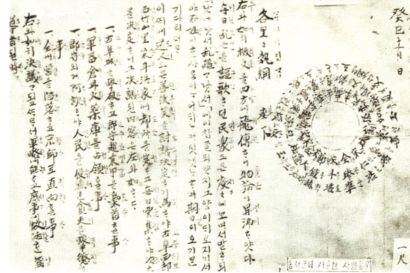
A document used by the Tonghaks.
Petition to the Emperor
As the Tonghak grew to become a force in Korean society, its energies were channeled into a movement to clear the name of the founder of the false charges under which he had been sentenced to death. This effort took overt form first in 1892, when several thousand Tonghak members gathered at Samnye in Cholla province and made demands on the governors of Cholla and Ch'ungch'ong that Ch'oe Che-u be posthumously exonerated and that suppression of the Tonghak be ended. The former demand was rejected on the ground that the governors lacked authority to take such action, but a pledge was given that local functionaries would be ordered to stop their persecution of Tonghak believers. Not satisfied with this, the assembled Tonghak followers resolved to carry their struggle to Seoul, to try to achieve their objective by petitioning the throne directly from in front of the palace gates. They carried out this resolve the following year, and when this form of protest also met with rejection, the petitioners in fact being dispersed by force, the order was given for Tonghak members to assemble again, this time at Poun in Ch'ungch'ong province. More than 20,000 heeded the summons to Poun, where they proceeded to erect defensive barricades, hoist banners, and call for a crusade to expel the Japanese and Westerners." The disconcerted authorities hardly succeeded in dispersing the Tonghak throngs by threatening the use of force, while at the same time soothing them with further promises to punish the functionaries who had persecuted the Tonghak most harshly.
Thus the growing strength of the Tonghak made continued prohibition of the faith futile, and this in turn led to still further expansion of the movement's appeal.
The Movement Grows, Chon Pong-chun acts against corrupt official
In 1894 the now expanded, well organized Tonghak movement erupted into a revolutionary peasant struggle employing military operations on a huge scale. The magistrate of Kobu county, Cho Pyong-gap, was known for his tyrannical cruelty, and since assuming his post he had taken every opportunity to inflict torment on the hard-pressed people he governed.
He illegally extorted large amounts from the peasantry, for example collecting over 1000 yuan (equivalent perhaps to 1500 contemporary U.S. silver dollars) to erect a covering structure over his father's tombstone. But what most evoked their bitter protests was the tax he enforced on irrigation water from the Mansokpo reservoir. He had mobilized the peasants to labor on a new reservoir constructed on a site just below the old one, and yet he now extorted more than 700 sok of rice in water use charges from the very peasants whose sweat and toil had built the reservoir. The enraged people of Kobu had repeatedly petitioned for redress of their grievances, but to no effect. At this point, under the leadership of the head of Kobu county's Tonghak parish, Chon Pong-chun, the peasants occupied the county office, seized weapons, distributed the illegally collected tax rice to the poor, and then destroyed the Mansokpo reservoir.
A call to arms
When a report of the incident reached the government, a specially empowered inspector was dispatched to investigate. This official, however, charged the Tonghak with responsibility for the uprising and, drawing up a roster of Tonghak members, arrested some and summarily executed others, meanwhile committing the further outrage of burning Tonghak homes. Further inflamed by this cruel denial of simple justice, the peasants rallied around Chon Pongchun, Kim Kae-nam, Son Hwa-jung, and other Tonghak members and rose again. A call to arms now went out to the peasants, appealing to them to rise in defense of the nation and to secure the livelihood of its people. The peroration of this proclamation read as follows:
The people are the root of the nation. If the root withers, the nation will be enfeebled. Heedless of their responsibility for sustaining the state and providing for its people, the officials build lavish residences in the countryside, scheming to ensure their own well-being at the expense of the resources of the nation. How can this be viewed as proper? We are wretched village people far from the capital, yet we feed and clothe ourselves with the bounty from the sovereign's land. We cannot sit by and watch our nation perish. The whole nation is as one, its multitudes united in their determination to raise the righteous standard of revolt, and to pledge their lives to sustain the state and provide for the livelihood of the people. However startling the action we take today may seem, you must not be troubled by it. For as we felicitously live out the tranquil years ahead, each man secure in his occupation - when all the people can enjoy the blessings of benevolent kingly rule, how immeasurably joyful will we be!
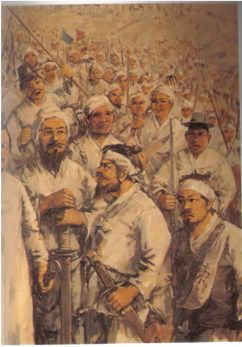
Now peasants from all the surrounding areas came to join forces with the Tonghak army, swelling its ranks to some several thousands. They wrapped multicolored cloth around their heads and waists, and for weapons they had a few rifles or swords or lances they had seized, but otherwise they mostly had only bamboo spears and cudgels. Nevertheless, holding aloft their distinctive yellow flags and protected from bullets, they believed, by the amulets they wore, the Tonghak peasant soldiers were fairly spoiling for a fight, After occupying Kobu they moved their base.
Early Tonghak Victories
Tonghak soldiers
Massed now in battle formation, the Tonghak peasant army first crushed the government troops sent from Chonju at Hwangt'ohyon hill in Kobu (Go-bu Jeollabuk-do ) on January 11, 1894, then in turn seized Chongiip, Koch'ang, and Mujang, and still advanced southward took control of Yonggwang and Hamp'yong Their ranks meanwhile had increased to over 10,000 men. The government in Seoul already had dispatched Hong Kye-hun to suppress them, in command of an elite battalion of about 800 men from the Seoul garrison. By the time he reached Chonju, however, his force had been cut in half by desertions, and so despite its superiority in weapons and timely arrival of reinforcements, there was no way it could defeat the confident, spirited Tonghak soldiery. Routing Hong Kye-hun's troops at Changsong, the Tonghak army pushed north against virtually no resistance and occupied Chonju.
Government panics, asks China for military support, Truce
Officers in the Chosen (Joseon) army 1890s
In a state of panic, the government hastily appealed to China for military support. China's response was immediate, and within a month a sizeable force had landed at Asan Bay. Japan, however, also sent in troops, and thee two powers faced each other in an increasingly tense confrontation. Convinced now that the Tonghak must be appeased by whatever means and its army of peasants dispersed, the government proposed that a truce be negotiated. Informed of the government's willingness to listen to Tonghak demands, Chon Pong-chun regarded this as an opportunity to archive his objectives without further recourse to warfare. In consequence hostilities came to an end, on condition that an end also be put to government misrule.
The Tonghak demands in this regard were the same as when they took up their arms: first that the yangban be prevented from draining the ' life-blood 'of the peasants by their illegal extortions; and secondly, the government block the inroads of foreign merchants. At this point the Tonghak peasant soldiers withdrew from Chonju and returned to their homes, while a separate Tonghak force that had arisen C'h'ungch'ong province also dispersed. But with the announced aim of establishing congregations in every village, the Tonghak extended their organized network into area after area. In the fifty-three counties of Cholla province in particular, so-called Local Directorates (Chipkangso) were established and set about reforming local government abuses. These popular organs, headed by a director and staffed by clerks, existed in parallel with the formal county administration, and in the provincial capital at Chonju Headquarters Directorate (Taedoso) was established with Chon Pong-jun "' its helm. On the whole the positions in the Local Directorates went to those with knowledge of administrative matters . The proposed reform program was as follows :
1. Eliminate the chronic mistrust between Tonghak believers and the government and cooperate in dealing with problems of administration. 2. Investigate the crimes of venal and corrupt officials and punish the guilty severely. 3. Sternly punish men of wealth who owe their fortunes to high-handed extortionate practices. 4. Discipline those yangban in or out of office whose conduct is improper. S. Burn all documents pertaining to slaves. 6. Rectify the treatment of those engaged in the "seven despised occupations" (lackeys attached to government offices and laborers assigned to perform certain arduous services for the state) and free the paekchjinng outcasts once and for all from the wearing of their distinctive "P'yongyang hat." 7. Permit the remarriage of young widows. 8. Ban collection of all arbitrary and irregular taxes. 9. In employing officials, break the pattern of regional and class discrimination and appoint men of talent. 10. Severely punish those who collaborate with the Japanese. 11. Cancel all outstanding debts, whether owed to government agencies or to private individuals. 12. Distribute land equally for cultivation by owner-farmers.
The principal concerns expressed here are, in sum, that the oppressive treatment of the Tonghak by the government and the yangban be stopped, an end be put to excessive economic exploitation of the peasantry, that discriminatory treatment based on social class status be abolished, that those guilty of collusion with the Japanese in their aggressive designs be punished. This revolutionary program to be implemented through the Local Directorates was welcomed with the greatest enthusiasm of the peasantry. Thus the powerful appeal of the Tonghak movement was felt not only in Cholla but spread into the other southern provinces as well, and even far northward into P'yongang and Hamgyong.
Japanese troops firing on Tonghaks
The pause in the fighting, however, had worked to the disadvantage of the Tonghak peasant army, for the explosive situation created by the presence of both Chinese and Japanese troops in Korea soon led to the outbreak of the Sino-Japanese War (in late July, 1894) and Japan's exercise of virtual control over all internal security matters in Korea.
Map of Tonghak battles Later in the year, in October, the Tonghak again took up their arms and began to move northward, with the avowed intent of expelling the Japanese. But they were defeated in fighting at Kongju against government troops reinforced by a Japanese army contingent, and they met defeat again at T'aein, at the decisive Battle of Ugeumchi. The Japanese had cannons and other modern weapons, whereas the Korean peasants were armed only with bow and arrows, spears, swords, and some flintlock muskets.
Tonghak leader Chon Pong-chun ( Jeon Bong-jun ), who was betrayed and arrested in 1894 and later executed. The vigorous battle started on October 22, 1894 and lasted until November 10, 1894. The poorly armed peasants stormed the well-entrenched Japanese, but they were beaten back and suffered heavy losses. The remnants fled to various bases. The triumphant Japanese pursued the army and eventually wiped it out. Jeon Bong-jun, the Donghak commander, was captured in March 1895. In 1898, the execution of Choe Si-hyeong followed.Although the revolution failed, it made a significant contribution to Korean modernization that resulted from the peasants' demands of democracy, expulsion of foreign influence and an end to feudalism
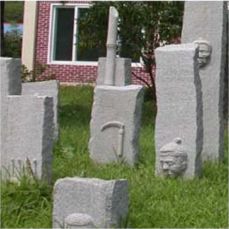
Tonghak memorial
Background for the Tonghak Rebellion, Unrest Among the Peasantry
Japanese exports flooded into Korea
Despite the critical international situation Choson now faced, the government lacked any coherent policy. This government of King Kojong and the Min family oligarchs could only think to maintain itself in power hy seeking the backing of foreign states, not by winning the support of the Korean people. Meanwhile the nation's chronic financial crisis had further worsened. On the one hand special exemptions, abandoned fields, and tax evasion had diminished the government's receipts, while at the same time developments subsequent to the opening of Korean ports-the exchange of diplomatic missions, the payment of indemnities to Japan, and the introduction of modern facilities-required new and heavy expenditures. These needs in part were met from customs receipts and from foreign loans, hut government activities still had to be financed preponderantly by the farming villages. The burdens on the peasantry thus doubled or even tripled, and every pretext was used to impose fresh levies and the petty functionaries who collected them resorted to ever more harsh methods of extortion. Under these circumstances the grievances harbored by the peasants toward their yangban rulers gave every indication of erupting into violence. Indeed, popular uprisings were breaking out in many areas, while armed bandits were raiding periodic markets and other centers of goods distribution with alarming frequency.
At the same time, Japanese economic penetration was further eroding Korea's village economy. Although Japan had been the first to take aggressive advantage of Korea, Japan's position in the peninsula inevitably deteriorated because of its involvement in the failed 1884 coup. Nevertheless,by the early 1890's Japanese economic activity had reached astonishing proportions that no other nation could rival. The establishments of Japanese merchants were to be found on a large scale in each of the open ports, Inch'on, Pusan, and Wonsan, and statistics for 1896 show that 210 of 258 such businesses were Japanese. Japan also enjoyed a heavy preponderance with respect to numbers of merchant vessels entering Korean ports. Among 1,322 merchant ships with a gross tonnage of 387,507 entering Korea's ports in 1893, 956 weighing 304,224 tons were Japanese; in percentage terms 72of the vessels and over 78 % of the gross tonnage came in underthe Japanese flag. Accordingly, Japan's proportion of the total volume of Korea's foreign trade loomed correspondingly large: over 90% of exports went to Japan and more than 50% of imports came from Japan. A full breakdown is shown in the following table.
KOREA'S FOREIGN TRADE BY COUNTRY IN 1893 Unit: yen COUNTRY EXPORTS (%) IMPORTS (%) China 134,085 ( 7.9) 1,905,698 ( 49.1) Japan 1,543,114 ( 90.9) 1,949,043 ( 50.2) Russia 20,917 ( 1.2) 25,414 ( 0.7) TOTAL: 1,698,116 (100.0) 3,880,155 (100.0)
The principal import item, cotton cloth, came in both from China and Japan, but whereas Chinese merchants simply were reexporting English cotton goods, Japanese traders increasingly brought in cloth manufactured in their own country. Korean exports, chief among which were rice, soy beans, gold, and cowhides, went almost entirely to Japan. It must be noted, too, that Japanese traders mostly were from the lawless or depressed elements of Japan's society, and they showed no scruples in their eagerness to make their fortunes at the expense of the Korean peasant. Shrewdly taking advantage of the fact that the village people could only buy Japanese cotton goods, kettles, pots and pans, farming tools, kerosene, dyestuffs, salt, and other things by selling their rice, Japanese traders would loan their victims the money with which to make purchases and then at harvest time claim a part or even all of the peasant's crop.
Living as they were in such straitened circumstances, the Korean peasants could not resist the glitter of the Japanese goods, only to find themselves made destitute by the exorbitant interest extorted by the profit-hungry Japanese. One way the government found to resist Japan's economic penetration was to prohibit the export of rice from certain provinces. Such bans were put into effect for Hamgyong province in 1889 and for Hwanghae in 1890, but Japanese protests rendered them ineffective. Due to a combination of factors, then, the villages continued to sink into destitution, while the peasantry harbored a mounting hostility toward its exploiters, Korean and foreign alike.
China and Japan Compete for Ascendancy
Unable to suppress the struggle of the Tonghak peasant army with its own forces, the Korean government had requested assistance from Ch'ing China. Perceiving this to be an opportune occasion to solidify its deteriorating position in Korea, China dispatched a force of 3000 men under Yeh Chih-ch'ao to land at Asan Bay. This action was reported to the Japanese government, in accordance with the terms of the Convention of Tientsin.
No less than China, Japan too now saw an opportunity to expand its influence in Korea. Japan not only hoped to restore its position of political primacy but also was keenly aware of the need to ensure a Korean market Accordingly, under pretext of protecting its citizens resident in Korea, .Japan landed a large force of 7000 troops at Inch'on, backed by seven warrships. By this time, however, the Tonghak peasant army already had withdrawn from Chonju, so that the ostensible reason for stationing Chinese and Japanese troops in Korea no longer existed. Recognizing this, China proposed a joint withdrawal to Japan, and this proposal was supported both by the Korean government and by the foreign powers. However,determined to take advantage of the situation to completely eliminateChinese power in Korea, Japan rejected the Chinese plan. In turn, then,Japan suggested that the two powers jointly undertake to reform Korea'sinternal administration. For the record, Japan argued that reform was absolutely essential if internal unrest were not again to flare into open rebellion, and that peace in East Asia depended on preventing such an occurrence. This was merely a pretext, however, and in fact Japan's pur pose was to raise an issue unacceptable to China and then seize upon it as an excuse to open hostilities. China of course rejected the proposal as constituting interference in the internal affairs of another nation, where upon the talks became deadlocked and a clash between China and Japan became inevitable.
The Sino-Japanese War began with a preemptive attack by Japanese war ships at Asan Bay in July, 1894, and it ended in a Japanese victory early in 1895. In the ensuing Treaty of Shimonoseki concluded between the two powers, China's acknowledgment of the full independence of Korea was detailed in the very first article. the modern weapons and training of the Japanese troops. In the end, then, struggle as they might against the yangban power structure within and the aggressive forces of foreign imperialism from abroad, the Tonghak peasant soldiers were caught in a vise between the two and were crushed.
|
||||
|
The samurai invasion |
||||