|
The Park Chung Hee Government 1961 - 1979
Seoul a few years after the war General Park Chung Hee, right The Rhee regime became increasingly dictatorial and corrupt until it was forced out of office by a student led revolt. in 1960.On 16 May 1961, led by General Park Chung Hee, a group of mid- and upper-level officers forced the resignation of President Yun and established a military government in an effort to restore order to the political and social chaos and pull the country out of its economic malaise. Park was a Japanese trained officer who had flirted with communism after the Japanese surrender. Kin Il Sung sent a trusted aide to talk with Park, Park had him arrested and executed. Martial law was instituted, the National Assembly dissolved, political party politics stopped, and the first five-year economic plan created. All functions of government were taken over by the Supreme Council for National Reconstruction (chaired by General Park), which had many military and supportive civilian leaders in top posts.
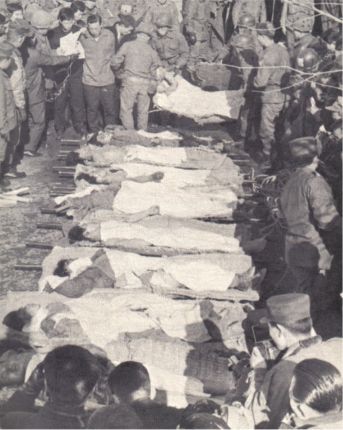
The only survivor of a 31 man assassination team from North Korea disguised as South Korean soldiers ids bodies of his comrades in 1968. 68 South Koreans and 3 Americans were killed trying to capture them.Three days later, January 23, the USS Pueblo was captured by North Korea Through 1963 dissatisfaction with military rule grew. The government had engineered no major breakthroughs and had seen many of its policies fail. An outcry of protest met Park's announcement that military rule would be extended for four additional years. In response to internal and external pressures, the extension was canceled and elections for civilian leaders took place in October 1963. Running as a civilian candidate, Park Chung Hee barely beat the recently deposed Yun Po-son. He narrowly won -again over Yun-in 1967. Over vocal opposition from minority party members, a 1969 constitutional amendment allowed the president to run for a third four-year term, and in 1971 he squeaked by the new opposition leader, Kim Dae Jung. Realizing that he was losing control over the currents of Korean society, Park pushed for extensive revisions of the constitution. The Yushin Constitution was ratified in 1972 and Park Chung Hee was once again reelected. Among other powers, the revised constitution gave the president unlimited six-year terms of office, the ability to rule by executive order, and the right to appoint one-third of the membership of the National Assembly. The Yushin Constitution went into effect over loud cries of dissent.
Martial law was declared and an executive decree made it illegal to criticize the president or his policies. To its credit, the Park regime brought about considerable changes in Korean society, including rapid economic advancement. Big business became the bedfellow of government. (Small businesses grew at a much slower pace.) Broadening its economic base, Korea moved from agriculture into heavy industry and chemicals. The new export-oriented economy relied upon a constant flow of imported raw materials to produce exportable products. At first, most of the fruits of production went abroad to gain needed revenue. By the late '70s, though, quality items began appearing on the Korean market, coinciding with a rise in the standard of living. The military grew, and with the perceived increasing threat from North Korea, a homeland reserve force was instituted in 1968. Diplomatic efforts led to improved international relations and more involvement in Asian affairs. By the mid-1960s, Korea had about 50,000 troops in Vietnam-and were some of the most feared of foreign troops-to fight on behalf of the southern half. In 1965, Korea renewed diplomatic relations with Japan, which had been cut since the end of WW II. Although protested by students, this was a healing of wounds and an opportunity to get much-needed financial aid to fuel the growing economy, the latter a key factor to the viability of the regime and its acceptance by the people. South Korea sent 300,000 troops to Vietnam . Many North Vietnamese considered the South Koreans the toughest opponent . South Koreaunder the administration of Park Chung-hee, took an active role in the Vietnam War. From 1964 to 1973, South Korea sent more than 300,000 troops to Vietnam. The South Korean Army, Marine Corps and Navy, Air Force all participated as an ally of the United States. The number of troops from South Korea was much more than Australia and New Zealand, second only to the US Military Force. The military commander was Lieutenant General Chae Myung-shin, ROK Army. Forces White Badge Tiger Division Combat Forces Troops South Korea in Vietnam The Saemaul ("New Village") program was instituted in 1971 as a self-help program for farmers. Although seen by some as a tool for government indoctrination, it did bring many benefits to the rural poor. The program later spread to fishing communities and then to urban areas. Due to various reforms, Korea became virtually self-sufficient in food production by the mid-'70s. Throughout the '60s and '70s, a reawakening of cultural activities was helped along by broadening mass communication and education.
Introduction of Saemaul Undong . Saemaul Undong was a movement of sustainable development in the Republic of Korea to transform South Korea from a developing to a developed country in a single generation. launched on April 22, 1970 by South Korean president Park Chung-hee to modernize the rural South Korean economy. The idea was based on the Korean traditional communalism called Hyangyak (향약) and Doorae (두레), which provided the rules for self-governance and cooperation in traditional Korean communities. Though hailed as a great success in the 1970s, the movement lost momentum during the 1980s as the economic situation and political environment in South Korea changed rapidly. wikipedia
The Miracle of the Han River - Park Chung Hee
Secrets behind Korea`s Economic Success With many of these advances, however, came the sacrifice of traditional values and a bit of the Korean "soul." With the emphasis on the country's overall improvement, the average citizen was often neglected. Human rights and civil liberties suffered, and dissent was squelched. Education and the media were heavily influenced and even censored by the government. Even with the dissatisfaction in some sectors of society, if President Park had stepped down after his second term he would have been revered today as a farsighted national hero who helped bring economic vitality to the country, and its politics from chaos to the' beginnings of democratic enlightenment. However, he did not step down. His last terms in office, and the effects of the Yushin Constitution, turned many Koreans against him, diminished his credibility drastically, and led to his untimely demise. In 1968 and 1975, assassination attempts against Park by North Korean agents failed; in the latter his wife was killed. These incidents helped push President Park into seclusion. He ran again in 1978 and won. Students again took to the streets, while other segments of society were feeling fed up as well. There was growing sentiment that some drastic change had to occur before the glimmer of democratic process was snuffed. The country no longer had an unsophisticated populace, and voices grumbling for change became numerous. Change came unexpectedly. On 26 October 1979, President Park was shot and killed by his trusted associate Kim Chae-kyu, head of the Korean CIA.
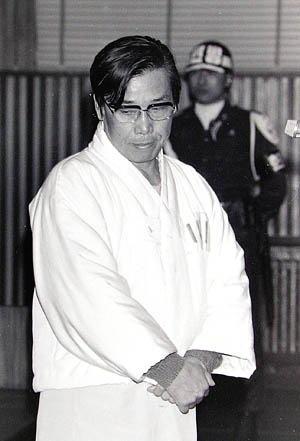
Kim Jaegyu, former Director of the Korean Central Intelligence Agency who assassinated Park Chun Hee . He did this, he said to restore democracy . He was hanged in 1980. On October 26, 1979, South Korean president and dictator Park Chung-hee was assassinated by his intelligence chief Kim Jae-kyu. Many people had hopes of democracy until this happened on December 12, 1979. Background: On the day of assassination, Kim Jae-kyu invited Army Chief of Staff Jeong Seung-hwa to KCIA safehouse where Park Chung-hee was to be assassinated in hope of getting his support. Jeong did not support Kim, and the latter was arrested later. Prime Minister Choi Kyu-ha became the acting President, and the martial law was desclared with Chief of Staff Jeong as the martial law administrator in fear of the attack by North Korea. Major Gen. Chun Doo-hwan, Chief of Security Command, was in charge of investigating the assassination of Park Chung-hee. He had formed a secret society of military officers called Hanahoe with Park's blessing.
Park Chung-Hee Assassination (The President's Last Bang) The assassination of Korean President Park Chung-Hee (박정희) as depicted in the 2005 film "The President's Last Bang" (그때 그사람들)
President Choi Kyu-hah 1976-79 After the assassination of Park Chung-hee in 1979, Choi, the prime minister of South Korea at the time, assumed power. Because of the unrest resulting from Park's authoritarian rule, Choi promised democratic elections (the elections led by Park were widely seen as flawed), as well as a new constitution to replace the highly authoritarian Yusin Constitution.
The Kwangju uprisng of 1980
U.S. news reports on the Kwangju uprising
In December 1979, Major General Chun Doo-hwan and close allies within the military staged a military coup against Choi's government. They quickly removed the army chief of staff and by early 1980 virtually controlled the government. In April 1980, due to increasing pressure from Chun and other politicians, Choi appointed Chun as head of the Korean Central Intelligence Agency. In May, Chun declared martial law and did away with all trappings of civilian government, becoming the de facto ruler of the country. By then, student protests were escalating in Seoul and Gwangju. The protests in Gwangju continued, resulting in the Gwangju Massacre, where around 987 civilians were killed within five days by Chun's military. Choi resigned soon afterward. Chun became president on September 1, 1980. After his resignation, Choi lived quietly out of the public eye. He died on October 22, 2006.
President Chun Doo-hwan 1980-88 As president, Chun promoted strong centralized government, and the rapid economic growth of the Park era continued.During Chun's visit to Rangoon, Burma (now Myanmar) in 1983, a bomb exploded at a mausoleum he was about to visit, killing 21 people, including South Korean Cabinet members. Chun himself narrowly escaped death as he arrived at the scene two minutes late. While no firm evidence of North Korean involvement has been established, they are widely suspected to have been the responsible party.On November 23, 1988, the embattled Chun chose to go into the Baekdamsa Buddhist temple as a symbolic gesture of repentance for the excesses of his regime. He spent two years in Baekdamsa. Chun was sentenced to death in 1996 for authorizing the Gwangju massacre, but later pardoned by President Kim Young-sam on the advice of then President-elect Kim Dae-jung, whom Chun himself had sentenced to death some 20 years earlier.
Rangoon Bombing ( warning - graphic content ) On October 9, 1983, President Chun Doo-hwan was on an official visit to Rangoon, the capital of Burma. During the visit he planned to lay a wreath at the Martyrs' Mausoleum to commemorate Aung San, who founded the independent Burma and was assassinated in 1947.As some of the president's staff began assembling at the mausoleum, one of three bombs concealed in the roof exploded. The huge blast ripped through the crowd below, killing 21 people and wounding 46 others.Three senior South Korean politicians were killed: foreign minister Lee Beom-seok, economic planning minister and deputy prime minister Suh Suk Joo, and minister for commerce and industry Kim Dong Whie.14 Korean presidential advisers, journalists, and security officials were killed; 4 Burmese nationals, including 3 journalists, were also among the dead. President Chun was saved because his car had been delayed in traffic and was only minutes from arriving at the memorial. The bomb was reportedly detonated early because the presidential bugle which signalled Chun's arrival mistakenly rang out a few minutes ahead of schedule. source wikipedia
APTV Looks back on the events which culminated with Chun being sentenced to death and Roh facing years in jail. Chun Doo-hwan and Roh Tae-woo were childhood friends who followed each other into the military and now they will be following each other to prison. Chun was sentenced to death by a panel of three judges after being found guilty of overthrowing the government in 1979. Chun made himself president in 1980 and was succeeded by Roh Tae-woo eight years later. Roh helped Chun to seize power and then to put down pro-democracy protestors in the southern city of Kwangju. The government admitted that 240 people were killed and a further 18 hundred wounded. Human rights groups say the death toll was much higher.Chun was later pardoned by President Kim Young-sam on the advice of then President-elect Kim Dae-jung
President Roh Tae-woo 1988-93 Roh's rule was notable for hosting the Seoul Olympics in 1988 and for his foreign policy of nordpolitik, which represented a major break from previous administrations. True to his word, he remained committed to democratic reforms. In 1993, Roh's successor, Kim Young-sam, led an anti-corruption campaign that saw Roh and Chun Doo-hwan on trial for bribery.
South Korean President Roh Tae-woo arrest on corruption charges. Roh admitted in a nationally televised address late last month that he amassed a 650 (m) million dollar slush fund during his term in office. He also admitted he left office with 230 (m) million dollars in secret bank accounts. The scandal has drawn in the nation's biggest conglomerates and threatens to topple several top politicians. After twenty hours of interrogation, former President Roh Tae-woo emerged from the prosecutors' office. He had just been issued an arrest warrant charging Roh with two counts of accepting bribes. The first is 31 (m) million dollars from the Daewoo group in return for a major submarine depot and 300 (m) million from 30 top companies. Prosecutors indicated that other people, including some top businessmen, could be arrested in connection with the scandal. Roh has admitted taking money from businesses, claiming they were making donations. But prosecutors said they have evidence of bribery.
SOUNDBITE: (Korean) I apologise deeply to the people of Korea. I will take full responsibility for this scandal and I am ready to accept any punishment. I am very sad that because of this scandal many businessmen have been through many difficulties. I would like to ask the Korean people to make sure that the businesses do not fall behind economically or internationally by looking after them and giving them strength and support. I'd like to tell the politicians one thing I will bear all the mistrust and conflict. I will take these with me. I will take any punishment. Please let this be a lesson to you. Do away with the distrust and conflict. Create a new political culture through understanding and cooperation. Let's leave this for the next generation. Thank you.
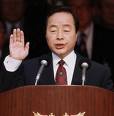
President Kim Young-sam 1993-98 the first civilian President of South Korea since a series of dictatorships beginning with Park Chung-hee. Kim Young-sam was inaugurated on 25 February 1993 and served a single 5-year term. He presided over a massive anti-corruption campaign, the arrest of his two predecessors, and an internationalization policy called Segyehwa.Kia Motors collapsed soon thereafter, setting off a chain of events which embroiled South Korea in the 1997 Asian Financial Crisis during the last year of his presidency.
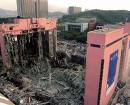
The Sampoong Department Store collapse in 1995 killed 502 and exposed governmental corruption
Sampoong Department Store Collapse The Sampoong Department Store collapse was a structural failure that occurred on June 29, 1995, in the Seocho-gu district of Seoul, South Korea. The collapse is the largest peacetime disaster in South Korean history as 502 people died and 937 were injured. Watch documentary .
Former S. Korea President Kim Young-sam passes away at 87 November, 22 2015 President Kim Dae-jung 1998 - 2003
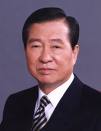
news report on Kim Dae jung A look back on the life of South Korean President Kim Dae-Jung Kim Dae-jung was 2000 the Nobel Peace Prize recipient.Kim Dae-jung took office in the midst of the economic crisis that hit South Korea in the final year of Kim Young-sam's term. He vigorously pushed economic reform and restructuring recommended by the International Monetary Fund. State subsidies to large corporations were dramatically cut or dropped. His policy of engagement with North Korea has been termed the Sunshine Policy . Kim Dae jung died on August 18, 2009 .
A final interview with Kim Dae-Jung He gave one of his final interviews to Amnesty International. In it he talks about the importance of abolishing the death penalty and about how when he was sentenced to death he was offered a change to cooperate with the, then, regime if he would give up his work and how he decided not to accept.
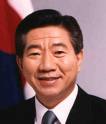
President Roh Moo-hyun 2003- 2008 Roh's election was notable for the arrival to power of a new generation in Korean politics, the so-called 386 Generation . People in their thirties when the word was coined, who had attended university in the 1980s, and who were born in the 1960s. One year and two months after leaving office, Roh became the center of an ongoing bribery scandal. Roh committed suicide on 23 May 2009 by jumping from a mountain cliff, after leaving a suicide note
news report on the death of Roh Moo hyun
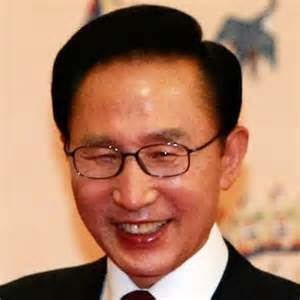
President Lee Myung-bak 2008- Feb 25, 2013 A Japanese-born Korean Politician and is the President of South Korea. Prior to his presidency, he was the CEO of Hyundai Engineering and Construction, and the mayor of Seoul. An important part of his platform was the Grand Korean Waterway (한반도 대운하) project from Busan to Seoul, which he believes will lead to an economic revival.Lee also discussed the ratification of the U.S.-Korea Free Trade Agreement or KORUS FTA, which faces opposition from legislators in both countries. Lee altered the South Korean government's approach to North Korea, preferring a more hardline strategy in the wake of increased provocation from the North.
Grand Korean Waterway Top #12 Facts
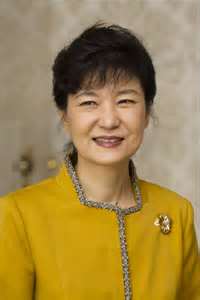
Park Geun-hye Feb 25, 2013 - present Park Geun-hye (박근혜 born 2 February, 2 1952) is the eleventh and current President of South Korea. She is the first woman to be elected as President in South Korea . Her father was Park Chung-hee, President of South Korea from 1963 to 1979 . Park's mother was assassinated in the National Theater of Korea, Seoul, by Mun Se-gwang, a Japanese-born North Korean assassin on August, 15 1974. She was regarded as first lady until 1979 when her father was also assassinated–by his own intelligence chief, Kim Jae-gyu, on October, 26 1979. She has a platform of "economic democracy" to see a greater spreading of wealth away from the chaebols as income distribution has become more unbalanced. Many South Koreans felt former President Lee Myung-bak may have gone too far with his hard line stance with North Korea and President Park supported less confrontation and more engagement with North Korea during her election bid.
Park Geun-Hye's life shaped by politics
The ferry MV Sewol sank on April 14, 2014, killing 304 passengers and crew . Watch documentary .
Reforming South Korea's chaebol South Korea’s corporate model of tightly knit companies that act in concert under family control is under scrutiny after Hyundai’s $10bn purchase of a plot of land in Seoul’s Gangnam district.
|
||||
|
1950-53 |
||||