|
|
Japanese invasions of Korea (1592-1598) 임진왜란 文禄慶長の役 Imjin War
The Japanese Invasion of 1592
Admiral Yi Sun-sin who saved the Joseon dynasty(Medieval dynasty of Korea) from the invasion of Japanese is the most admired figure in Korea. He was true hero and smart inventor of battleship. You can watch what he did for his country and people through this video.
The Admiral: Roaring Currents Official US Release Trailer
When Korea began to suffer sporadic attacks on its coasts by the Japanese in the mid-16th century, the government created a Border Defense Council (Pibyonsa), jointly staffed by civil and military officials, and entrusted to it all matters in respect to the country's defense. But the yangban bureaucrats, accustomed to the ways of peace and not easily bestirred, were content to take only temporizing measures. At this very time a new situation was unfolding in Japan, as Toyotomi Hideyoshi brought an end to the internal disorders of the so-called age of Warring States. Having succeeded in unifying the country, Hideyoshi sought to direct the energies of his commanders outward, thereby to enhance the solidarity and tranquility of Japan itself. He had been stirred, too, by what he had learned of the wider world beyond Japan's shores, and there grew within him a reckless ambition to launch an invasion through Korea against the Ming empire itself.
Video of the battle of Okpo, May 7, 1592.The Battle of Okpo was a 2 day fight around the harbor of Okpo at Geoje Island in 1592. It was the first naval battle of the Imjin War and the first victory of Admiral Yi. The Battle of Okpo caused anxiety and nervousness among the Japanese, because afterward Yi began to deploy his navy to attack Japanese supply and carrier vessels.
The Japanese army made its landing at Pusan in the spring of 1592. Chong Pal, commander of the Pusan garrison, and Song Sang-hyon as the magistrate of Tongnae, defended the two beachhead areas to the death but in the end were overwhelmed, and the Japanese launched a three-pronged attack northward toward Seoul. The stunned government now pinned its hopes on Sin Ip, who had won repute in his successful campaign against the Yain (Jurchen) in the north. But when Sin Ip met defeat in a battle at Ch'ungju, King Sonjo took flight toward Oiju on the Yalu River, sending two of his sons to raise fresh troops in defense of the kingdom in Hamgyong and Kangwon provinces.
Video of the battle of Sacheon, May 29, 1592. This and was the first battle in the Imjin War when the Turtle Ship was used
The populace at large was infuriated at the government's incompetence and irresponsibility. As Sonjo and his high officials abandoned Seoul in flight the people blocked their way, hurling insults at them. Once the king and his retinue had left Seoul, the city's slave population set fire to the registry where the slave rosters were kept and to the offices of the Ministry of Punishments. The two princes found none who would respond to their call to arms, and in the end they were captured by the Japanese. The blame for this wretched state of affairs lay with the government officials, who had failed to concern themselves with the welfare of the people and had caused the farming villages to fall to ruin. Nearly the whole of the country, now defenseless, was trampled over by the Japanese armies. They were a military force experienced in land warfare, blooded in the many campaigns of Japan's Warring States period, and moreover they possessed firearms. There was no reason to expect that Korea's meager, untrained battalions might hold out against them. It was at this point that Yi Sun-sin, Naval Commander of Left Cholla province, began to make his presence felt in the struggle. Appointed to his post the year before, Admiral Yi had keenly felt the need to strengthen
Video of Battle of Myeongnyang Oct 27, 1597. the Korean admiral Yi Sun-sin fought the Japanese navy at sea in Myeongnyang Strait, near Jindo Island. With only the 13 ships remaining from Won Gyun's disastrous defeat at the Battle of Chilchonryang, Admiral Yi Sunsin held the strait against a fleet of 133 Japanese warships and at least 200 Japanese support ships. Many Japanese warships were sunk or disabled during the battle and the Japanese were forced to retreat. Given the disparity in numbers, the battle is regarded as one of Admiral Yi's most remarkable victories.
Battle of Myeongnyang, October 26, 1597
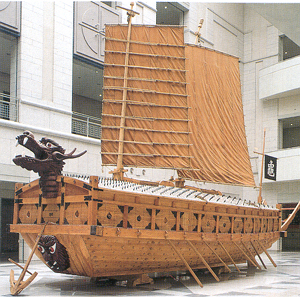
A reconstructed turtle boat of Yi Sun sin
The Turtle ship, also known as Geobukseon (거북선), was a type of large Korean warship that was used intermittently by the Royal Korean Navy during the Joseon Dynasty from the early 15th century up until the 19th century. It was used alongside the standard Korean Panokseon warships in the fight against invading Japanese naval ships. The ship's name derives from its protective shell-like covering. The first references to older, first generation turtle ships, known as Gwiseon (귀선; 龜船), come from 1413 and 1415 records in the Annals of the Joseon Dynasty, which mention a mock battle between a gwiseon and a Japanese warship. However, these early turtle ships soon fell out of use as Korea's naval preparedness decreased during a long period of relative peace.
the country's naval forces, and he had energetically set about building warships and training their crews. In particular, on the model of vessels already in use in the mid-fifteenth century, he built his famed "turtle ships" (kobukson) with a protective covering (thought to have been iron plated) to ward off enemy arrows and shells, and in addition with numerous spikes implanted to prevent the enemy from boarding. He also placed cannon around the entire circumference of the ships, so that attack could be made at will from any side. His preparations made, Yi Sun-sin set forth
Naval battle of Hamsan-do
with his warships to destroy the Japanese fleet whenever and in whatever waters it might appear. Victorious in his first encounter at Okp'o, he continued to carry the day in successive battles at Tangp'o, Tanghangp'o, Hansan Island, and Pusan . The battle in the seas off Hansan Island is especially famous as one of the three great victories of the war against the Japanese. Admiral Yi's successes gave complete control of the sea lanes to the Korean forces, with the result that the Japanese efforts to move north by sea and effect a link with their land armies were crushed. Moreover, the fact that the grain-rich region of Cholla province remained safely in Korea's hands also was owing to Admiral Yi's achievements. Not only this, but his operations imperiled Japanese supply routes, hampering their freedom to launch fresh attacks.
Meanwhile, within the borders of the country, guerrilla forces sprang into existence on all sides. The same populace that had reacted indifferently to the government's efforts to muster fresh troops now spontaneously took up arms in defense of their homes. Typically, yangban, peasant farmers, and slaves in a single district coalesced around a guerrilla leader and, as their strength grew, gradually expanded the area of their operations. The guerrilla leaders generally were Neo-Confucian literati of high repute in their locales, among them such outstanding figures as Cho Hon, Kwak Chae-u, Ko Kyong-myong, Kim Ch'on-il, and Chong Mun-bu. Cho Hon rose in Okch'on, in Ch'ungch'ong province, and routed the Japanese from Ch'ongju, only to be killed in an assault on Kumsan. Kwak Chae-u assembled a guerrilla force in Uiryong, Kyongsang province, and drove the Japanese out of the Uiryong-Ch'angnyong area; he went on to join with Kim Si-min in repulsing the enemy's first attempt to take Chinju. Ko Kyong-myong led a guerrilla force northward from his home in ChanghUng, but he too died in the attack on Kumsan. Kim Ch'on-il repeatedly harassed the Japanese forces around Suwon and later took part in the second battle of Chinju, where he was killed. Chong Mun-bu, on the other hand, was active in Hamgyong province in the north, where he recaptured Kyongsong and Kilchu, and he also forced the Japanese to withdraw from Kangwon province. These constitute only a few of the hundreds of guerrilla units that sprang up large and small, among which even were bands of Buddhist monks led by such honored figures as the monks Hyujong (Sosan Taesa) and Yujong (Samyong Taesa). The hit and run thrusts of the Korean guerrilla forces often dealt severe blows to Japanese military operations.
The Battle of Noryang, the last major battle of the Japanese invasions of Korea (1592-1598), was fought between the Japanese navy and the combined fleets of the Joseon and Ming navies. It took place in the early morning of 16 December (19 November in Lunar calendar), 1598 and ended past dawn. The allied force of about 150 Joseon and Ming Chinese ships, led by Admiral Yi Sun-sin and Chen Lin, attacked and either destroyed or captured more than half of the 500 Japanese ships commanded by Shimazu Yoshihiro, preventing his link-up with Konishi Yukinaga. The battered survivors of Shimazu's fleet limped back to Pusan and a few days later, left for Japan. At the height of the battle, Admiral Yi was shot with a Japanese arquebus, and died shortly after.
Ming China intervenes
Ming Crossbowmen vs Samurai Matchlocks
Moreover, a Ming Chinese relief army had arrived, 50,000 strong. With Li Ju-sung at its head, the Ming army succeeded in recapturing P'yongyang and pursued the Japanese southward. But after being defeated in a battle at Pyokchegwan just north of Seoul, the Chinese pulled back to P'yongyang and for the time being remained there, inactive. Korean forces under Kwon Yul meanwhile had taken up positions in the mountain redoubt at Haengju on the north bank of the Han River"with the intent of attacking in concert with the Chinese forces to retake Seoul. But when the Ming army withdrew to P'yongyang the Korean defenders were left isolated, to face alone repeated large-scale assaults against their bastion launched by the Japanese. They succeeded in repulsing the Japanese in each of these bloody battles, and the victory they won there at Haengju is remembered too as one of the three great Korean triumphs in the 1592 struggle against the Japanese invaders.
Negotiations for peace now got underway and the Japanese forces withdrew to the southeastern littoral of Kyongsang province. About this time the Japanese, who had been beaten back by Kim Si-min in an earlier assault on Chinju, attacked the town once again, and despite a heroic defense led by Kim Ch'on-il and Hwang Chin, in the end Chinju fell. The struggle to hold Chinju against these two separate Japanese sieges was no less fierce a conflict than the battle at Haengju, and the first, successful defense of Chinju occupies a special place among the three great Korean victories of the war.
Repulse of the Japanese and the Impact of the War
In the first flush of their invasion the Japanese land forces had swept over the whole country, but their navy had been defeated and control of the seas had been wrested from them. Moreover, harassed by Korean guerrilla attacks, the Japanese were beating a steady retreat southward. At the same time, the Ming army in P'yongyang finally was stirred to action by the Japanese withdrawal from Seoul. Instead of engaging the Japanese forces in battle, however, the Chinese advanced in screen formation in the wake of the retreating enemy, content thus simply to prevent the Japanese from regrouping and again attacking northward. It was this situation that led to the opening of truce talks between Ming and Hideyoshi. The negotiations, however, eventually were broken off. On the one hand, the Chinese sought to resolve the situation in their favor by accommodating Japan within the Chinese tributary system , establishing Hideyoshi as the king of Japan and granting him the privilege of formal tribute trade relations with Ming China. Hideyoshi, for his part, regarded himself as the victor, and so he responded with the absurdly unrealistic proposal that a daughter of the Chinese emperor be given to wed the emperor of Japan, that a portion of Korea be ceded to him, and that a prince of Korea and several of its high officials be sent to Japan as hostages. With such fundamental differences in bargaining positions, there was no prospect whatsoever for negotiations to succeed.
After the rupture of the long drawn out peace talks, the Japanese launched 11 second campaign to conquer Korea, in 1597. This time, however, things did not go as planned for the Japanese army, for the Koreans now were equipped and ready, and the Ming relief army too moved quickly into action. In consequence, the Japanese land forces could achieve no more than local success in engagements confined largely to Kyongsang province. At sea, on the other hand, the Japanese navy now was operating with unaccustomed audacity. This was because, as a result of intrigue against him in Seoul, Admiral Yi Sun-sin had been dismissed as Commander-in-Chief of the Naval Forces of the South and replaced by Won Kyun, who then was overwhelmingly defeated in an encounter with the Japanese fleet. The dismayed government hastily reinstated Admiral Yi who, with the mere dozen warships remaining in his command, engaged a Japanese flotilla as it was sailing toward the Yellow Sea off Myongnyang, near Mokp'o, and won a resounding victory.
Driven back into a shrinking perimeter along the south central and southeastern coastal regions, the Japanese army now found itself hemmed in both by land and sea. At this point in mid-1598 Hideyoshi died, and this led the Japanese to withdraw completely from the peninsula before the year was out. Attacking the retreating Japanese forces to the very end, Admiral Yi Sun-sin was felled by a chance enemy shot in the seas off Noryang point.
In the course of the seven-year struggle nearly the whole of Korea's eight provinces became an arena of Japanese pillage and slaughter, but Kyongsang province suffered most severely. The population markedly decreased, and whole villages were laid waste. Famine and disease ensued, and it was these conditions that gave impetus to the compilation after the war of great medical treatises such as the Exemplar of Korean Medicine (Tongil pogam).
In order to overcome its financial difficulties resulting from the shortage of food grains, the government resorted to selling office titles and ranks in exchange for grain contributions (napsok) in fixed amounts. As a consequence of the terrible suffering the war had visited on the populace at large, uprisings also broke out on all sides, the most serious being that led by Yi Mong-hak in Ch'ungch'ong province in 1596. Moreover, with the destruction of land and census registers, the government was hard put to collect taxes and enforce corvee levies. The loss of cultural treasures in fires set by the Japanese troops also was substantial, including the wooden structures at Pulguk-sa in Kyongju and Kyongbok Palace, while the volumes stored in three of the four History Archives (Sago) were reduced to ashes. On the other hand the war with Japan brought advances in military tactics, for example the Chekiang order of battle used by Ming forces, and new weapons such as the "heaven-shaking explosive shell" and a kind of mobile rocket launcher were developed.
The impact of the war with Japan was felt not alone by Korea, for it was a conflict of a magnitude that shook the whole of East Asia. The Jurchen people who grew in power at this time in Manchuria, while Ming was busied in Korea, were soon to conquer Ming and make themselves masters of China. In Japan, too, the Tokugawa house established a new military regime. At Japan's request Korea entered into friendly relations with the Tokugawa Shogunate from 1606, but the animosity of the Korean people toward Japan remained alive long thereafter. Not only did the war bring about political changes in the countries of East Asia, but it had a marked cultural impact as well. Japan benefited in particular from the abduction of skilled Korean potters as prisoners of war, who then became the instruments of great advance in the ceramic art of that country. The numerous books seized by the Japanese in Korea also contributed to the development of learning in Japan, especially the study of Neo-Confucianism.
|
|
||
|
|
1392-1910 |
|
||