|
THE JAPANESE COLONIAL PERIOD 1910 - 1945
Japanese Troops marching through the West Gate in 1904
Japanese rule in Korea only lasted 35 years yet left an indelible legacy. The country was relentlessly modernized with new roads, railroads, telegraph lines and new schools .However, Koreans became worse off as time went on. Per capita rice consumption went down as more was exported to Japan. All of the top positions were held by Japanese .In the 1930s Japan began a program to erase the Korean national identity by banning the use of the Korean language in schools and requiring all Koreans to adopt Japanese names . After 1939, the trend was to integrate Koreans into the mainstream of Japanese society, albeit only as an underclass. Many Japanese emigrated to Korea, and Korea had a Japanese civilian population of 850,000 by the end of World War II, with about 240,000 in the colonial government. By 1905 Japan had thwarted Chinese and Russian bids for influence over the Korean Peninsula and felt comfortable in demanding of Korea a relationship to her benefit. The 1905 Taft-Katsura agreement in effect gave tacit U.S. approval to the Japanese colonization of the peninsula in exchange for Japanese recognition of U.S. influence over the Philippines. Without opposition in Korea, in November 1905 Japan concluded a treaty with King Kojong, making Korea a protectorate and giving herself control over Korea's foreign relations and external matters. The Japanese resident general also slowly took over internal affairs. With the forced abdication of the king in 1907, his son Sukjong took the throne. Japan pressured him to abdicate three years later and formally annexed the country in April 1910. Both treaties were signed in secret; the king and his ministers were so weak by now that they feared the Japanese more than the retribution of their own people. With an official stamp of approval, Japan acquired Korea without a shot. Calling the peninsula Chosen, Japan ruled Korea for the next 35 years (1910-45).
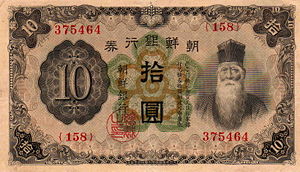
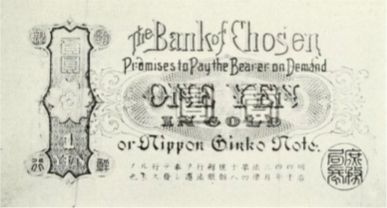
The yen was the currency of Korea between 1910 and 1945
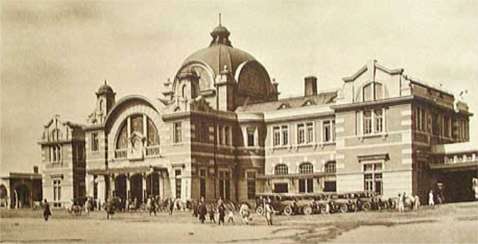
Seoul Train Station, designed by Tsukamoto Yaushi in the mid 1920s
Seoul streetcar 1904 One of the first items of business was a survey of Korean land. Numerous Japanese came to Korea to farm and to fish its bountiful waters, while high taxes and fixed crop prices forced thousands of Korean farmers to move to Manchuria or relocate to Japan as laborers. Japanese big business and semi governmental organizations established a near monopoly on commerce, industry, and mining. Progress in agriculture, energy, transportation and communications systems, monetary control, and commercial distribution was all for the benefit of the Japanese and to facilitate their conquest of Asia.
The twelve chapters in this volume seek to overcome the nationalist paradigm of Japanese repression and exploitation versus Korean resistance that has dominated the study of Korea's colonial period (1910 - 1945) by adopting a more inclusive, pluralistic approach that stresses the complex relations among colonialism, modernity, and nationalism. By addressing such diverse subjects as the colonial legal system, radio, telecommunications, the rural economy, and industrialization and the formation of industrial labor, one group of essays analyzes how various aspects of modernity emerged in the colonial context and how they were mobilized by the Japanese for colonial domination, with often unexpected results
The largest uprising against Japanese rule occurred in March, 1919 after a failure of the Korean delegation to gain the rights of self-determination at the Versailles Conference following WWI. Here university students demonstrate.
Trial of some of the participants in the 1919 uprising. An estimated 1~2 million Koreans took part with some 7,000 being executed.
Newsreel of Korea in the early 1930s under the Japanese .
The first western hotel in Korea, The Chosun Hotel, built in 1914. President Herbert Hoover stayed her when he visited Korea in 1915.
Honmachi Street ( now Myeong-dong ) in Keijo (Seoul)
Keijo in the 1930s, The Bank of Korea is on the left and a large sign in Japanese for 'Lait Cream'.' Photo probably taken from the Mitsukoshi department store.
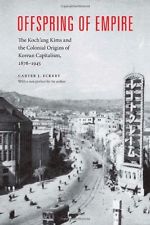
Offspring of Empire: The Koch'Ang Kims and the Colonial Origins of Korean Capitalism, 1876-1945 Focusing his study on one powerful clan of Korean businessmen, Eckert examines the extent to which Japanese imperialism molded modern Korean capitalism.
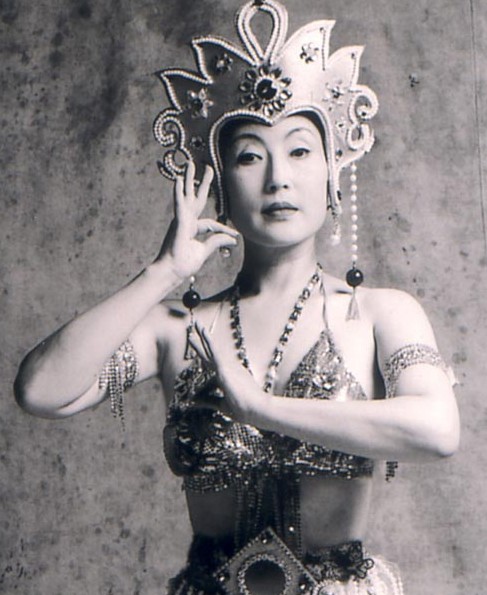
Popular singer and dancer Choi Seung-hee(1911-1969), singing "A garden in Italy'(1936).Choi was born into a yangban-class family in Seoul, Korea during the Japanese occupation, and was also known by the Japanese pronunciation of her name, Sai Shoki.After graduating from Sookmyung High School at the age of fifteen, she went against her father's wishes to study under modern dancer Baku Ishii in Japan, where she distinguished herself as one of the most talented dancers. She developed her own modern dances inspired by Korean folk dances, which had been considered as lowly works.After the start of the Sino-Japanese War in 1937, she was sent on tour of the front lines by the Imperial Japanese Army for propaganda purposes and to raise troop morale. After the end of World War II, she went to North Korea with her husband, who was an active supporter of the Workers' Party of Korea. She established a dance school and was given an official position within the North Korean administration. In 1951, she was asked to visit Beijing to perform for Chinese premier Zhou Enlai. However, in 1967, she was purged by the party, and disappeared from public view. However, on February 9, 2003, an official announcement was made that she had died in 1969. The circumstances surrounding her death remain a mystery.
Rare 1938 color footage of Korea. This rare 16mm COLOR(Kodachrome) footage of Seoul was filmed in March 1938, by Thor Wiestlandt, a Swedish diplomat who stayed in Japan from 1936 to 1939.
Broadly speaking, the first decade of colonial rule was one of stern military rule and suppression. Koreans were not permitted to participate politically and they were disenfranchised from nearly all aspects of economic, social, and political life. The '20s and '30s saw a move to civilian rule and a somewhat conciliatory mood. Social and political activity was relaxed and Koreans were allowed a role of consultation in some affairs. After 1939, the trend was to integrate Koreans into the mainstream of Japanese society, albeit only as an underclass.
One of the righteous armies' that were formed in the early 1900s after the Japanese occupation. In 1907 a righteous Army of 10,000 tried to liberate Seoul but were defeated.Most of the resistance armies in the south were hunted down, while those in the north survived by being able to retreat and resupply in Manchuria and Russia.
A Korean resistance fighter in Manchuria in the 1930s
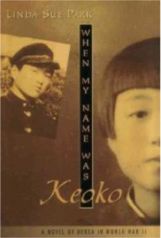
(Jane Addams Honor Book (Awards) Alternating between the voices of a brother and sister living with their parents and uncle in WW II-era Korea, this family saga explores the consequences of Korea's prolonged conflict with Japan. Named one of the Best Children's Books 2002 by Publishers Weekly. After the Korean military was disbanded in 1907, an organization known as the "righteous army" was formed. For five years, this ragtag group of guerrilla fighters, although not broadly effective, was a thorn in the side of the Japanese. During the public mourning for the late King Kojong, Korea experienced its largest popular uprising during the colonial period, the March First Movement. On that day, 33 religious leaders signed a declaration of independence in Seoul. When it was read to the public, people flooded the streets and rose up in popular support. This movement spread swiftly to the countryside, where tens of thousands participated in demonstrations and civil disobedience for several weeks. Taking the authorities by surprise, this outpouring of national sentiment was brutally repressed. In the end, the uprising brought about only minimal change. Ironically or perhaps not so, this popular protest against repression won little support from Western governments then posturing as defenders of self determination. However, it did stir Korean emotions, and enabled the formation of independence groups in the U.S., Manchuria, and southern Russia.
The future premier of North Korea, Kim Il Sung and his first wife Kim Jong suk, met as Japanese resistance fighters in the Soviet Union
comfort women With the Japanese push into China in the late '30s, Korea was used as a staging point for military activities. Crops were taken to feed troops and Korean boys were drafted. Others were taken to serve in fields and factories in other parts of the growing Japanese empire, and young women were forced into service as prostitutes ("comfort women"). At this time there was a concerted effort to extinguish the idea of "Koreanness" and turn all Koreans into Japanese though keeping them second-class citizens. Japanese became the official language; during the latter years of control, Korean was neither taught in schools nor allowed in public. In place of Korean history and culture, the Japanese equivalents were substituted. Koreans were forced to adopt Japanese names and accept Shinto as the state religion. The Japanese governor general became the ultimate authority in Korea. Japanese held all top level government positions, though Koreans were used as lower level functionaries and local administrators. A Japanese controlled police system was instituted and all dissent was stifled. Outspoken newspapers were shut down and all political activity was banned. In late March and April 1919, provisional governments were formed in Vladivostok, Shanghai, and Seoul, but they were ineffectual because of factional infighting. Most resistance to the Japanese took place on the peninsula in a quiet way: in the form of mutual self-help groups and social clubs, in institutions and literature promoting Korean history, culture, and the arts, and in religious activities that pushed for freedom of thought. Vocal and violent outbreaks occurred in 1926 after the death of Korea's last king, and in a 1929 student demonstration in Kwangju.
A war correspondent's reports on Korea after its liberation from Japan in 1945 and after communist destruction of the country and its people in 1950. Watch video .
After Japan surrendered on Aug 15, 1945, Koreans took off their Japanese clothes and appeared in Korean clothes Japanese Shinto shrines and torii gates were torn down and burned. Russian troops entered Pyongyang on August 24 where they were welcomed by cheering crowds. However, some of the troops began to rob and rape the citizens. Many Japanese factories in Korea were seized and taken to the Soviet Union. Large landholding of the Japanese and Korean landlords redistributed.
The U.S. awakened to the importance of the peninsula, the 'dagger pointing to the heart' of the newly conquered Japan. The State Dept assigned two young officers in August 1945, one of which was Dean Rusk, to draw up a division of the Korean peninsula, which they did with a National Geographic map. This was done four days before the liberation of Korea.
|
||||
|
1950-53 |
||||